Check of high-pressure pump M57/M67/W17
The high pressure pump in the common rail system delivers fuel under high pressure into the rail. During operation, the three pistons of the high pressure pump generate pressure peaks in the rail which can be made visible by means of measuring the rail pressure sensor signal with an oscilloscope. The shape of the signal makes it possible to determine the mechanical status of the high pressure pump.
Test preconditions
- Fuel level sufficiently full (reserve fuel lamp must not light)
- No fault in fuel supply system
- No external leaks in common rail system
- No fault code stored for rail pressure sensor and rail pressure control valve
Evaluating the oscilloscope measurement
The figure below shows a rail pressure sensor signal that is in order thus indicating an intact high pressure pump. The signal pulsating uniformly at a period of approx. 25 ms and an amplitude of approx. 20 mV can be clearly seen. The maximum permissible value for the amplitude is 40 mV.
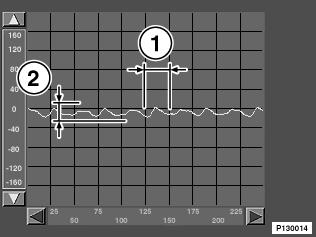
Fig. 1: OK signal
- Period
- Amplitude
In contrast to this, the next figure shows a signal that has been generated by a defective high pressure pump (one piston of the pump failed). The following factors characterise the difference compared to Fig. 1:
- Considerably longer periods (approx. 100 ms)
- Higher amplitude (max. permissible: 40 mV)
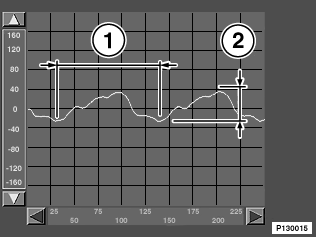
Fig. 2: not OK signal
- Period
- Amplitude