Retractable hardtop
Retractable hardtop
For the first time, a retractable hardtop is deployed in the new Convertible of the BMW 3 Series_E93. The three-part roof construction has been manufacture from sheet steel plate using the lightweight construction method. The roof opens in approx. 22 seconds and closes in approx. 23 seconds.
The retractable hardtop provides the following advantages:
- A high degree of on-road comfort with the roof closed with increased suitability for daily use
- Good all-round view with the roof closed on account of the narrow C-pillar as well as large rear window
- Opening and closing with a total height of 170 centimetres, which means it is also possible in garages
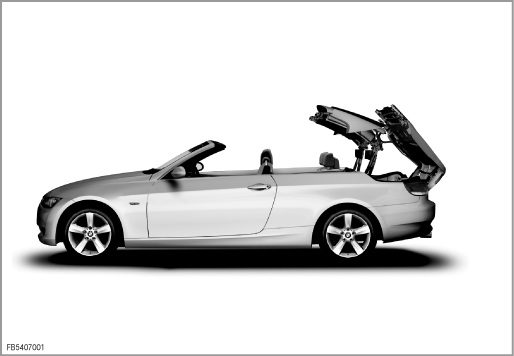
A central hydraulic unit drives the retractable hardtop. The sequence of movements is supported by 8 hydraulic cylinders. 6 gas-pressurized props are also involved in the sequence of movements. The hydraulic unit is activated by the Convertible Top Module (CTM). A total of 14 sensors monitor the sequence of movements.
Important! Emergency actuation only in service.
Emergency actuation of the retractable hardtop for the customer is not implemented. However, emergency actuation is possible in Service.
The emergency actuation is described in detail in the repair instructions.
Brief description of components
The following components are described for the retractable hardtop:
Micro-switch on the retractable hardtop
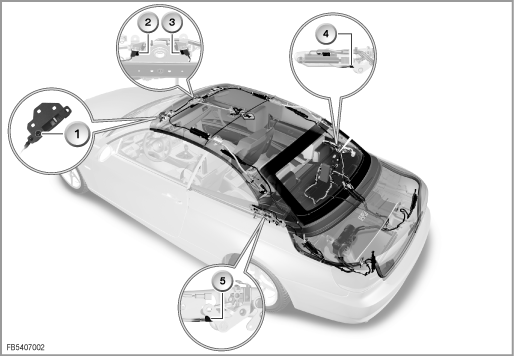
A total of 5 micro-switches deliver a signal to the Convertible Top Module (CTM):
Index |
Explanation |
Index |
Explanation |
|---|---|---|---|
1 |
Micro-switch 'cowl panel reached' |
2 |
Micro-switch 'cowl panel unlocked' |
3 |
Micro-switch 'cowl panel locked' |
4 |
Micro-switch 'right-hand interlocking ring buckle closed' |
5 |
Micro-switch 'left-hand interlocking ring buckle closed' |
|
|
- Micro-switch 'cowl panel reached' (1)
This micro-switch is fitted in the vehicle in the cowl panel to the left. When the guide bolt of the front roof shell has reached the cowl panel, the micro-switch is opened. From this position onwards, the drive for the hardtop interlock is activated. The roof shells are locked. - Micro-switch 'cowl panel unlocked' (2)
This micro-switch is installed to the left below the drive for the hardtop retainer. The contacts of the micro-switch are opened when the catches are fully locked. The catches can be locked at the cowl panel and at the base plate in the luggage compartment. When the hardtop is fully closed, the contacts of the micro-switch are open (high signal). When the hardtop is opened, the catches are unlocked and the contacts of the micro-switch are closed. After the roof package has been placed in the luggage compartment, the catches are locked at the base plate. The contacts of the micro-switch open. - Micro-switch 'cowl panel locked' (3)
This micro-switch is installed to the right below the drive for the hardtop retainer. The contacts of the micro-switch are closed when the catches on the cowl panel are fully locked. When a high signal is received by the CTM, opening of the catches of the hardtop is concluded. The retainers of the front roof shell to the middle roof shell and of all three roof shells are detached. When thereafter the roof shells are moved one on top of the other and placed in the luggage compartment, the contacts of the micro-switch remain opened. It is only when the catches start to lock that the contacts of the micro-switch are closed again. - Micro-switch 'right-hand interlocking ring buckle closed' (4), Micro-switch 'left-hand interlocking ring buckle closed' (5)
There are micro-switches on the left-hand and right-hand cylinders for the interlocking ring buckle. These micro-switches deliver a signal to the CTM when the interlocking ring buckle is locked.
Hall sensors on the retractable hardtop
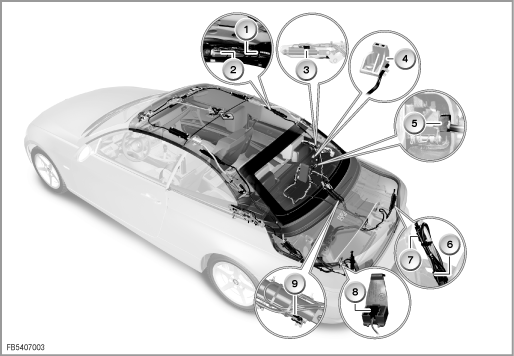
A total of 9 Hall sensors deliver a signal to the Convertible Top Module (CTM):
Index |
Explanation |
Index |
Explanation |
|---|---|---|---|
1 |
Hall sensor 'roof shells partially opened' |
2 |
Hall sensor 'roof shells partially closed' |
3 |
Hall sensor 'right-hand interlocking ring buckle opened' |
4 |
Hall sensor 'rear module closed' |
5 |
Hall sensor 'roof package stored' |
6 |
Hall sensor 'rear module almost closed' |
7 |
Hall sensor 'rear module opened' |
8 |
Hall sensor for luggage compartment partition |
9 |
Hall sensor 'roof package set up' |
|
|
- Hall sensor 'roof shells partially opened' (1), Hall sensor 'roof shells partially closed' (2)
Two Hall sensors are attached to the right-hand cylinder for the roof shells; these pick up the motion of the piston in the cylinder. When the piston is extended, a signal is sent by the Hall sensor 'roof shells partially opened' to the CTM. In this position, the roof shells are completely one on top of the other. Now the roof package can be stored in the luggage compartment.
The Hall sensor 'roof shells partially closed' sends a signal to the CTM when the piston has almost completely retracted into the roof shell cylinder. As of this position and until the cowl panel is reached, the hardtop closes more slowly (indirect anti-trapping mechanism). - Hall sensor 'right-hand interlocking ring buckle opened' (3)
This Hall sensor is located at the right-hand cylinder for the interlocking ring buckle. The Hall sensor delivers a signal to the CTM when the piston is fully extended. In this position, the retainers of the rear module and of the rear roof shell with the body are released. - Hall sensor 'rear module closed' (4)
This Hall sensor is installed on the front right of the main bearing. The Hall sensor delivers a signal to the CTM when the rear module has reached the lowest position. There is a bracket on the rear module that triggers the signal when the end position is reached. - Hall sensor 'roof package stored' (5)
This Hall sensor is installed on the right-hand base plate in the luggage compartment. The Hall sensor delivers a signal to the CTM when the guide bolt of the front roof shell has reached the guide in the base plate. As of this position, the drive for hardtop locking can be activated and the rear module closed again. - Hall sensor 'rear module opened' (6), Hall sensor 'rear module almost closed' (7)
Two Hall sensors are installed on the right-hand cylinder for the rear module; these pick up the motion of the piston in the rear module cylinder. When the piston is extended, a signal is sent to the CTM. In this position, the rear module is fully opened. The roof package can be stored in the luggage compartment or raised from the luggage compartment. The Hall sensor 'rear module almost closed' sends a signal to the CTM when the piston has almost completely retracted into the cylinder. As of this position and until the end position is reached, the rear module closes more slowly. - Hall sensor for luggage compartment partition (8)
The Hall sensor for the luggage compartment partition reports that the luggage compartment partition is in the lower position. This means that an important condition for the function has been met. If this signal fails, the hardtop cannot be stored (closing is possible). The Hall sensor is installed on the left-hand rear module bearing. - Hall sensor 'roof package set up' (9)
A Hall sensor is attached to the right-hand main pillar ram; it sends a signal to the CTM when the piston has retracted into the main pillar ram. When the main pillar rams have been retracted, the roof shells are set up.
Button for operation
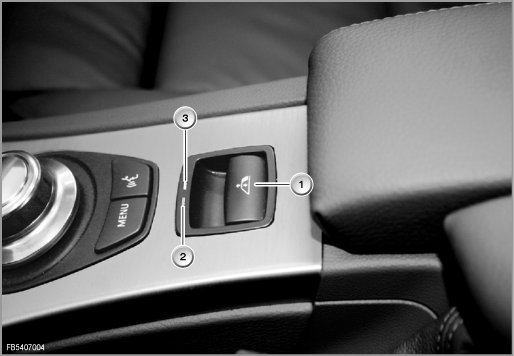
The button is in the centre console between the controller and armrest. The button for the retractable hardtop works in a similar way to a power window switch.
- Pulling and holding the button opens the retractable hardtop and the side windows.
- Pushing and holding the button closes the retractable hardtop and the side windows.
Index |
Explanation |
Index |
Explanation |
|---|---|---|---|
1 |
Button |
2 |
green LED |
3 |
red LED |
|
|
If the button is released during the movement, the motion of the retractable hardtop or side windows stops immediately. The function display on the button has 2 LEDs (red and green). The green LED lights up during opening or closing. The red LED indicates incorrect operation or incorrect conditions (e.g. luggage compartment partition not down).
The red LED flashes as soon as the hardtop is in an intermediate position and simultaneously no operation is attempted. Flashing does not indicate a fault. The flashing LED is intended to draw attention to the fact that the vehicle must not be driven in this state.
CTM: Convertible Top Module
The Convertible Top Module (CTM) is the central control unit for all functions of the retractable hardtop. The CTM is fitted on the right on the partition. The CTM controls the retractable hardtop, the rear module and the Soft Close Automatic system. The CTM controls the drive for hardtop locking. The CTM also controls the hydraulic pump and the 8 hydraulic cylinders via the 5 valves in the hydraulic unit.
The CTM is connected to other control units across the K-CAN. In this way, e.g., information on the outside temperature, driving speed and status of the luggage compartment lid is received via K-CAN. On opening and/or closing the hardtop, the CTM sends a signal to the Car Access System (CAS). The CAS is the master control unit for the power windows. The CAS sends CAN signals to activate the footwell module (FRM) as well as the junction box electronics (JBE). The signal serves as a request to lower the front and rear side windows.
In certain situations, the CTM issues instructions for the customer in the instrument cluster as Check Control messages.
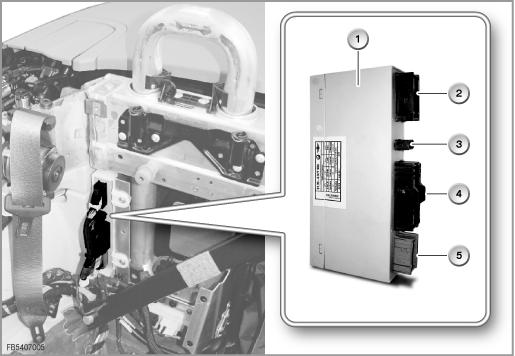
Index |
Explanation |
Index |
Explanation |
|---|---|---|---|
1 |
Convertible Top Module (CTM) |
2 |
26-pin connector for Hall sensors and micro-switches |
3 |
2-pin connector to the drive for the hardtop lock |
4 |
41-pin connector for power supply, Soft Close Automatic system, button, Hall sensors, micro-switches and K-CAN |
5 |
18-pin connector for activation of the hydraulic unit |
|
|
Depending on whether the roof is closed or opened
, the CTM sends a signal to the aerial diversity for the aerial changeover.
Drive for hardtop lock
The roof shells of the hardtop are interlocked. The front roof shell is also locked at the cowl panel by 2 catches. An electric motor in the front roof shell acts as the drive.
The electric motor drives the coiled cables on the left and right (similar to the slide/tilt sunroof). There are locking pins at the end of the coiled cables; these are pushed by the front roof shell into the middle roof shell. This locks these roof shells. At the same time, the middle roof shell is locked into the rear roof shell by means of a linkage system.
The catches are locked at the cowl panel. The middle engaging hook is also locked.
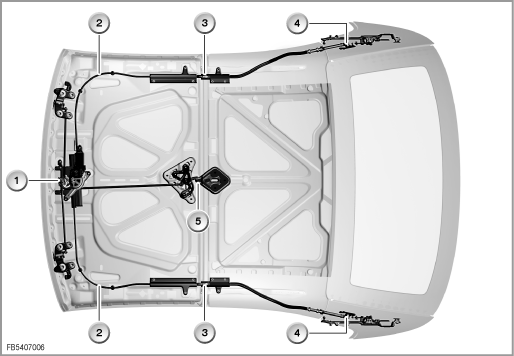
Index |
Explanation |
Index |
Explanation |
|---|---|---|---|
1 |
Drive for hardtop lock (electric motor) |
2 |
Coiled cable |
3 |
Locking pin, front roof shell to middle roof shell |
4 |
Locking pin, middle roof shell to rear roof shell |
5 |
Engaging hook |
|
Hydraulic unit
The hydraulic unit is located in a recess in the base of the luggage compartment.
The corresponding valve positions and direction of rotation of the hydraulic pump determine the direction of movement of the hardtop and of the rear module. The direction of rotation of the hydraulic pump is controlled by 2 relays.
The hydraulic pump creates an operating pressure of 150 to 200 bar.
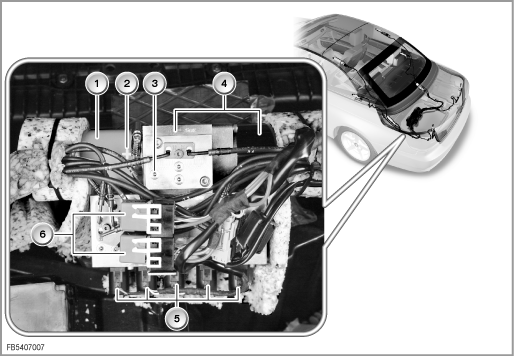
Index |
Explanation |
Index |
Explanation |
|---|---|---|---|
1 |
Container for hydraulic fluid |
2 |
Fill level mark |
3 |
Bolt for emergency actuation, non-pressurised system |
4 |
Hydraulic unit with hydraulic pump |
5 |
Hydraulic valves |
6 |
2 relays |
In order to prevent the hydraulic pump from overheating if the hardtop is operated frequently, the temperature in the hydraulic pump is measured. The temperature sensor is connected to the CTM by 2 wires without earth. A break in wiring leads to a fault code memory entry.
As of 90 °C, a hardtop closing movement that has already begun is continued up to a safe end position.
At 105 °C, the movement of the hardtop is stopped immediately. When the temperature falls below 90 °C, the movement can be continued.
KOMBI: Instrument cluster
The instrument cluster delivers the outside temperature (bus signal).
FRM: Footwell module
The footwell module (FRM) activates the front power windows. To open the hardtop, the side windows must be lowered (bus signal from CTM).
JBE: Junction Box Electronics
The junction box electronics (JBE) actuates the rear power windows. To open the hardtop, the side windows must be lowered (bus signal from CTM).
The junction box electronics deliver the signal as to whether the luggage compartment lid is closed (bus signal).
The distribution box in the junction box supplies the Convertible Top Module (CTM) with terminal 30g. In addition, the CTM is supplied with terminal 15 by the Car Access System (CAS). If, for example, the power supply from the junction box is interrupted, adequate communication with the BMW diagnosis system is still possible.
Aerial diversity
Depending on whether the roof is closed or opened, the CTM sends a signal to the aerial diversity. The aerial diversity then changes over the aerials accordingly.
System function
The following system functions are described for the retractable hardtop:
- Opening and closing the retractable hardtop
- Convenient operation and convenient loading
- Check Control messages
- Soft Close Automatic system
Opening and closing the retractable hardtop
To open and close the retractable hardtop, the following conditions must be met:
- Terminal R ON
- Outside temperature above -12 °C
- Luggage compartment lid (rear module) closed
- Vehicle stationary (driving speed 0 kph)
- Luggage compartment partition lowered
- Lateral inclination of the vehicle less than 11 °
- Power windows are initialised
- Battery voltage greater than 11.5 Volts
- Fewer than 5 opening and closing operations in succession
- Temperature of the hydraulic fluid for opening maximum 90 °C and for closing maximum 105 °C
When the button in the centre console is pulled, the conditions are checked by the Convertible Top Module (CTM). After a successful check, the side windows are lowered. At the same time, the front roof shell is unlocked at the cowl panel and the roof shells themselves are unlocked. Activating the hydraulic components unlocks the interlocking ring buckle (fastener for rear roof shell and rear module to body). The 3 roof shells are now moved one on top of the other. Then the rear module is opened and the roof package is stored. The stored roof package is then locked (similar to the way it is at the cowl panel). The rear module is then closed and locked. To conclude, the side windows move back up (only EURO version).
The hardtop closes in reverse order. When the button in the centre console is pulled, the conditions are checked by the Convertible Top Module (CTM). After a successful check, the side windows are lowered (green LED lights up). The rear module is unlocked and opened. Simultaneously, the roof package is also unlocked. When the rear module is fully opened, the roof package is set up. When the roof package has reached its end position, the rear module is closed, locked by the interlocking ring buckle and then unlocked again. Now the roof shells are moved apart until the front roof shell reaches the cowl panel. Now the roof shells themselves are locked and the front roof shell is locked at the cowl panel. Finally, the rear roof shell and the rear module are locked with the body. The green LED in the button goes out. If the button remains pressed, the side windows move upwards.
Convenient operation and convenience function for loading and unloading the luggage compartment
The retractable hardtop can be operated using the remote control as well as the mechanical key in the door lock. In the case of vehicles with the ”Comfort Access” optional extra, the hardtop can be opened and closed using the identification sensor.
The new convenience function for loading and unloading enables rapid access to the luggage compartment when the roof is open, e.g. when large items of luggage are loaded. The convenience function is activated as follows:
- Briefly press the luggage compartment button on the remote control
- Then press and hold down the luggage compartment button (no more than 1 second may elapse between releasing and pressing again)
First of all, the rear module is unlocked and completely opened. Then the roof package is swung out of the luggage compartment up to an intermediate position. Subsequently, the rear module is closed and locked. The luggage compartment lid is unlocked via the Soft Close Automatic system. Here, the luggage compartment lid opens slightly.
The convenience functions via the remote control are country-specific.
Conditions for operation with the remote control or identification sensor with Comfort Access (optional extra 322)
|
without optional extra 322 (Comfort Access) |
with optional extra 322 (Comfort Access) |
|---|---|---|
EURO and rest of the world |
Roof OPEN: even if remote control is more than 4 metres away Roof CLOSED: only if remote control is less than 4 metres away Convenience function for loading and unloading: even if remote control is more than 4 metres away |
Roof OPEN: even if identification sensor is more than 4 metres away Roof CLOSED: only if identification sensor is less than 4 metres away Convenience function for loading and unloading: even if identification sensor is more than 4 meters away |
USA/Canada |
--- (not coded) |
Roof OPEN: only if identification sensor is less than 4 metres away Roof CLOSED: only if identification sensor is less than 4 metres away Convenience function for loading and unloading: only if identification sensor is less than 4 metres away |
Check Control messages
In certain situations, it is not possible to open or close the hardtop. The corresponding messages are displayed in the instrument cluster as Check Control messages. On vehicles with a Central Information Display (CID), the short text and supplementary information are displayed.
The Check Control messages provide a better explanation of the red LED on the button, which lights up in the event of a fault. Any Check Control message that is present is displayed every 5 seconds.
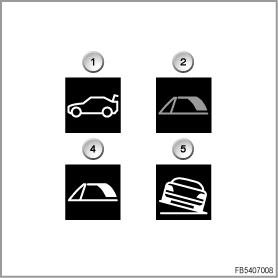
No. |
Colour |
ID |
Check Control message |
Supplementary information |
|---|---|---|---|---|
1 |
yellow |
19 |
Boot open! |
|
2 |
Red |
401 |
Roof mechanism function failure! |
Roof operation |
447 |
Roof operation! |
Roof operation |
||
558 |
Roof control failure! |
Roof control |
||
562 |
Roof not locked! |
Roof |
||
3 |
yellow |
416 |
Luggage compartment partition! |
Luggage compartment partition |
|
432 |
Roof drive overheating! |
Roof operation |
|
516 |
No roof operation possible! |
Roof |
||
519 |
No roof operation possible! |
Roof operation |
||
4 |
yellow |
445 |
Vehicle not standing on level surface! |
Roof operation |
Soft Close Automatic system
For convenient closing of the luggage compartment lid, the Soft Close Automatic system is installed as series standard. The Soft Close Automatic system consists of 2 drives. The drives lock the luggage compartment lid on the left and right at the support member of the rear module. This increases the stability of the rear end.
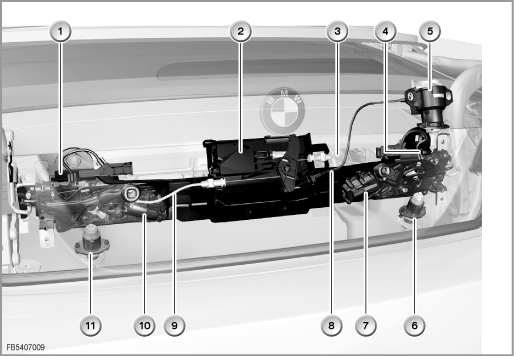
Index |
Explanation |
Index |
Explanation |
|---|---|---|---|
1 |
Micro-switch for luggage compartment lock, left |
2 |
Central-locking drive for luggage compartment lid |
3 |
Bowden cable for unlocking the luggage compartment lock, right |
4 |
Micro-switch for luggage compartment lock, right |
5 |
Lock cylinder in boot (rear) lid |
6 |
Bump stop, right |
7 |
Drive for Soft Close Automatic system, right |
8 |
Bowden cable for mechanical unlocking of the luggage compartment lid |
9 |
Bowden cable for unlocking the luggage compartment lock, left |
10 |
Drive for Soft Close Automatic system, left |
11 |
Bump stop, left |
|
|
When the luggage compartment locks on the left and right have reached the locking bracket, 2 micro-switches are pressed. The signals are sent to the junction box electronics (JBE). The Convertible Top Module (CTM) receives the signals across the CAN bus. The CTM then activates both drives of the Soft Close Automatic system until the luggage compartment lid is locked.
Banging the luggage compartment lid shut would make closing with the Soft Close Automatic system unnecessary. For reasons relevant to safety, it must be ensured that the luggage compartment lid really is closed. This is why the drives of the Soft Close Automatic system are activated in all cases.
Both drives have an anti-repeat circuit to prevent overheating. The anti-repeat circuit permits up to 20 activations of the Soft Close Automatic system (counter up to 20 increments). Thereafter, the Soft Close Automatic system is electrically blocked for approx. 2 minutes.
Notes for Service department
General information
Important! Emergency actuation only in service.
Emergency actuation of the retractable hardtop for the customer is not implemented. However, emergency actuation is possible in Service.
The emergency actuation is described in detail in the repair instructions.
Important! Vehicle must be stationary.
It is not possible to open and close the retractable hardtop while the vehicle is being driven.
On account of the high current consumption of the retractable hardtop of up to 40 Amperes, the hardtop may only be operated when a battery charger is connected or the engine is running.
Comply with the additional instructions in the Owner's Handbook.
Important! There is no anti-trapping mechanism for the rear power windows.
The rear power windows have no anti-trapping mechanism.
This means there is also no one-touch control function for closing the rear windows.
Note! No convenience closing via the outside door handle electronics.
On vehicles with Comfort Access, convenience closing is not possible using the outside door handle electronics. Convenience closing is run via lock cylinders.
Note! Maintenance-free hydraulic fluid.
Because of its life-time oil filling, the hydraulic fluid does not have to be renewed. If the hydraulic fluid has to be topped up due to leakage, only the approved hydraulic fluid may be used. Only add hydraulic fluid up to the mark on the oil reservoir.
Note! If excessive noise is generated, bleed the hydraulic system.
If excessive noise is generated while the hardtop is moving, the hardtop must be opened and closed several times. This will automatically bleed the hydraulic system in the oil reservoir.
Note! The hardtop weighs approx. 98 kilograms.
At least 2 persons should work on removing and installing the convertible roof, making use of a suitable lifting device (see repair instructions).
Diagnosis instructions
Important! When working on the rollover protection system, open the hardtop.
If the BMW diagnosis system triggers the rollover protection, the hardtop must be opened first of all. Otherwise, the rear window will be destroyed.
This also applies to mechanical triggering.
Notes on coding / programming
After replacement, the Convertible Top Module (CTM) must be recoded.
Country-specific versions
Bear in mind the different national versions for the convenience functions:
see section ”Convenient operation and convenience function for loading and unloading the luggage compartment”.
No liability can be accepted for printing or other errors. Subject to changes of a technical nature