Parking brake
Parking brake (electromechanical parking brake = EMF)
As series standard, the E89 is equipped with an electromechanical parking brake (EMF). The parking brake is the same as a handbrake. For the first time, the EMF actuator is integrated in the brake caliper. The parking brake is operated using the parking brake button in the centre console.
Deployment of the electromechanical parking brake has to the following advantages:
- Operation via the ergonomic button in the centre console
- Safe engagement and disengagement of the electromechanical parking brake (EMF) under all conditions
- Dynamic emergency braking function is ensured even with low coefficient of friction via the control systems (ABS)
- Space for additional storage options in the area of the centre console in that no parking brake lever is required.
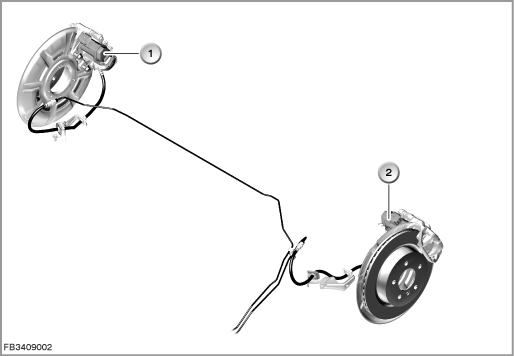
Index |
Explanation |
Index |
Explanation |
|---|---|---|---|
1 |
EMF actuator, rear right |
2 |
EMF actuator, rear left |
The parking brake is designed to secure the parked vehicle against rolling away.
When the engine is turned off, the EMF takes over braking: electromechanically via the two EMF actuators on the rear axle.
With the engine running, the dynamic stability control (DSC) engages the parking brake: hydraulically via the 4 wheel brakes.
Brief description of components
The following components are described for the parking brake:
EMF actuator
The EMF actuator is attached to the brake caliper and directly affects the brake piston.
The EMF actuator consists of an actuator motor and gears.
The two EMF actuators are activated by the EMF control module.
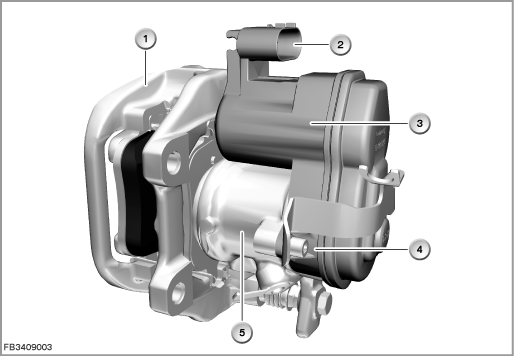
Index |
Explanation |
Index |
Explanation |
|---|---|---|---|
1 |
Brake caliper |
2 |
3-pin plug-in connection |
3 |
Servomotor |
4 |
Transmission |
5 |
Brake piston |
|
|
The power is transferred to a two-stage planetary gear train via the actuator motor and a belt drive. A shaft with nut in the brake piston ensures self-regulation. The power is transferred to the brake piston via the shaft and nut. The brake piston exerts force on the brake pads in the same way as hydraulic operation, and the pads are pressed onto the brake disc. The self-regulation of the shaft means that the tensioning force is retained. The vehicle is also held securely when no current is applied.
The temperature is picked up in each EMF actuator by a temperature sensor and transferred to the EMF control module.
EMF control module
The EMF control module is located in the rear right of the luggage compartment.
The EMF control module receives the driver's demand to engage the brake via the parking brake button on the centre console. The vehicle status is detected via the bus system. The EMF control module decides whether all the conditions for engaging have been complied with. If this is the case, the two EMF actuators on the rear brake calipers are activated.
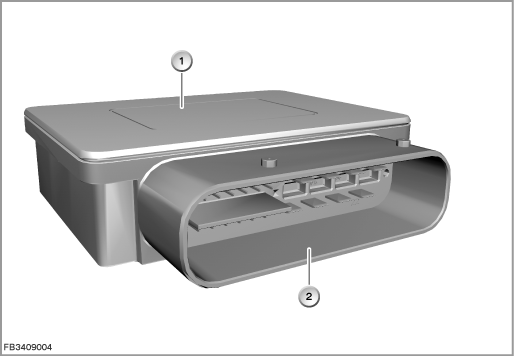
Index |
Explanation |
Index |
Explanation |
|---|---|---|---|
1 |
Control module for electromechanical parking brake (EMF) |
2 |
22-pin plug-in connection |
The EMF control module is supplied with terminal 30: by the front distribution box and twice by the distribution box on the battery.
Parking brake button
The parking brake button is located in the centre console behind the gear selector switch (GWS). The design of the parking brake button is based on the operations logic of a parking brake:
- Pull parking brake button upwards: the parking brake is activated
- Press parking brake button downwards: the parking brake is deactivated
The status ”engaged” is indicated by a red LED in the parking brake button as well as by the parking brake indicator lamp in the instrument cluster. If the parking brake of the vehicle has already been engaged, pulling the parking brake button again has no effect.
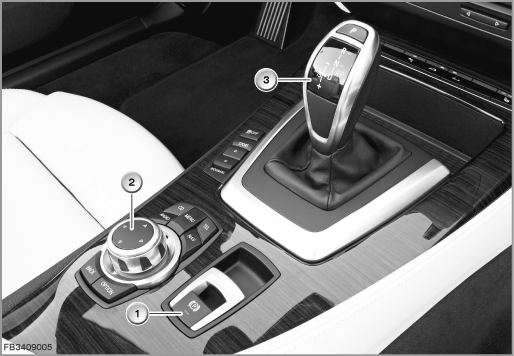
Index |
Explanation |
Index |
Explanation |
|---|---|---|---|
1 |
Parking brake button |
2 |
Controller (CON) |
3 |
Gear selector switch (GWS) |
|
|
The following additional control modules are involved in the electromechanical parking brake (EMF):
DSC: Dynamic Stability Control
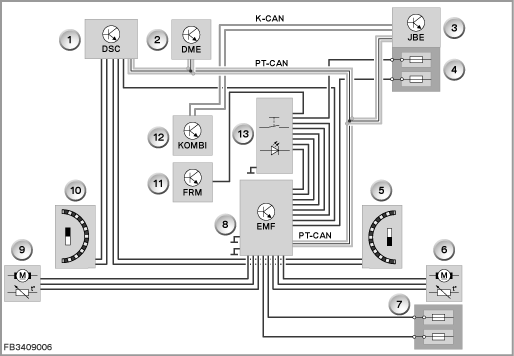
The dynamic stability control (DSC) is the master control module for the electromechanical parking brake (EMF).
With the engine running, the dynamic stability control (DSC) engages the parking brake. The DSC also delivers the conditioned wheel-speed in the form of a frequency-modulated signal to the EMF (determined from the speeds of the rear wheels). The signal is transferred across a separate line. The signal is particularly important for detection of the vehicle standstill. In addition to the plausibility check, the transmission output speed of the automatic transmission is used.
Index |
Explanation |
Index |
Explanation |
|---|---|---|---|
1 |
DSC (Dynamic Stability Control) |
2 |
Digital Motor Electronics (DME) |
3 |
Junction box electronics (JBE) |
4 |
Front distribution box |
5 |
Wheel-speed sensor, rear right |
6 |
Actuator motor, rear right |
7 |
Rear distribution box |
8 |
EMF control module |
9 |
Actuator motor, rear left |
10 |
Wheel-speed sensor, rear left |
11 |
Footwell module (FRM) |
12 |
Instrument cluster (KOMBI) |
13 |
Parking brake button with function indicator lamp |
|
|
Via DSC, dynamic emergency braking can also be initiated with the parking brake button.
DME: Digital Motor Electronics
The engine management system delivers the signal ”Engine running”. The signal is transferred across the PT-CAN.
EGS: Electric transmission control
The electric transmission control delivers the following signals:
- Selector-lever position (e.g. D):
this detects driving off against the parking brake (Check Control message). - Transmission output speed:
plausibility check of the speed signal.
KOMBI: Instrument cluster
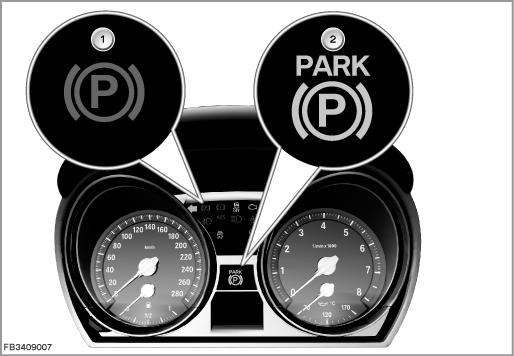
In the event of failure of or a fault in the EMF, the warning and indicator lamp for the EMF lights up. In addition, a Check Control symbol is displayed in the instrument cluster.
Index |
Explanation |
Index |
Explanation |
|---|---|---|---|
1 |
Warning and indicator lamp |
2 |
Check Control symbol |
If there is a Check Control message, additional supplementary instructions can be displayed on the Central Information Display (CID).
JBE: junction box electronics
The junction box electronics (JBE) form the gateway between the PT-CAN and K-CAN.
System functions
The following system functions are described for the parking brake:
- Engaging and disengaging
- Dynamic emergency braking
- Temperature monitoring
- Roll monitoring
- Safeguard at a standstill
- Braking-in after maintenance task
Engaging and disengaging
The brake is engaged by pulling the parking brake button.
With the engine running or rolling vehicle:
via the DSC, the handbrake is applied hydraulically on the disc brakes of the front and rear axles.
With the engine off and the vehicle stationary:
the parking brake is applied with the help of the EMF actuators to the service brake on the rear axle.
Driving off against the blocked brake pressure leads to another pressure increase and a Check Control message.
Starting the engine leads to a switch from electromechanical to hydraulic parking brake engagement.
The parking brake is disengaged by pressing the parking brake button.
The active brake system opens.
When the vehicle is stationary and the engine is running or off, it is only possible to disengage the parking brake with the brake pedal operated.
With the engine off (via bus signal ”status engine running”), there is a switch from hydraulic to electromechanical engagement of the parking brake.
Dynamic emergency braking
If the parking brake button is pulled while the vehicle is being driven, hydraulic braking occurs for 0.8 s with 3 m/s2. For the next 2 seconds, the braking power is increased (linear) to 5 m/s2.
As long as the vehicle is rolling and the engine is running, emergency braking is handled by the hydraulic components. With the engine off, emergency braking is handled by the mechanical system.
The braking is maintained by the DSC for as long as the parking brake button is pulled.
Here, all DSC control operations are executed as if via the brake pedal.
As the dynamic emergency braking acts hydraulically on all 4 wheels, significantly greater decelerations with a minimum of actuating force are possible compared to conventional parking brakes. For safety reasons, the following traffic is warned by the stop lamps in the event of dynamic emergency braking. Dynamic emergency braking via the handbrake is intended for emergencies and under no circumstances does it replace braking with the brake pedal.
If braking by the brake pedal and parking brake overlap, the DSC decides on the higher specified value. On emergency braking to vehicle standstill, the vehicle remains hydraulically braked even after the parking brake button is released. It is only when the parking brake button is pressed again that the hydraulic brake is released.
Temperature monitoring
The temperature monitoring balances out the reduction in power that occurs when the hot brake disc cools down. The temperature monitoring is activated as follows: The temperature during the state change of the parking brake from ”disengaged” to ”engaged” exceeds a defined value. The temperature is picked up in each EMF actuator by a temperature sensor and transferred to the EMF control module. During a state change, the higher temperature of the two brake discs is used for temperature monitoring. The corresponding temperature ranges with the associated re-tensioning times are stored in a characteristic map. Depending on the temperature during the state change, the corresponding re-tensioning times are activated from the characteristic map. The function terminates under the following conditions:
- Occurrence of a fault that prevents re-tensioning
- Switching off or resetting the control module
- Last re-tensioning finished
Roll monitoring
Roll monitoring prevents the vehicle with engaged parking brake from rolling away. The roll monitoring observes the wheel-speed signals of the braked wheels after the parking brake has been applied. The wheel-speed signal indicates that the vehicle is rolling away. If rolling away is reliably determined, the activated brake system re-tensions the brakes.
The roll monitoring is disabled on:
- Disengaging the parking brake
- Sleeping of the vehicle
Safeguard at a standstill
This function activates the mechanical brake application if the vehicle has to be additionally safeguarded when the hydraulic brake has been applied (e.g. driver leaves the vehicle).
The DSC control module detects when the driver leaves the hydraulically braked vehicle (CAN message, e.g. via seat occupancy detection). The DSC then requests the EMF to add mechanical brake application.
The EMF releases the additional braking when signals arrive that indicate the driver has returned.
Notes for Service department
General information
The exact procedure for braking in the service brake is described in the repair instructions. Follow the instructions there precisely.
The EMF control module detects the brake test unit on the basis of a plausibility check (comparison of the wheel speeds).
Diagnosis instructions
The following service functions are available in the BMW diagnosis system:
- Assembly mode
Before replacement of the brake pads, the service function 'Assembly mode' must be executed. The parking brake is moved into the opened position and temporarily disabled. Subsequently, the brake pad can be replaced.
As long as the parking brake is in the assembly mode, for safety reasons it is not possible to close the parking brake. If the parking brake button is activated despite this, the indicator lamp in the instrument cluster flashes yellow. The assembly mode is exited automatically at a driving speed above 3 km/h. - Commissioning
After an emergency release, it must be commissioned.
Procedure:- Ignition on
- Apply strong pressure to the brake pedal
- Hold the brake pedal pressed down
- Pull the parking brake button for approx. 10 seconds (engage)
- Press the parking brake button (disengage)
- Ignition on
Notes on encoding / programming
After replacement, the EMF control module must be encoded.
No liability can be accepted for printing or other faults. Subject to changes of a technical nature