Power management: closed-circuit current monitoring
closed-circuit current monitoring
The power management with IBS monitors the closed-circuit current of the vehicle in the idle state. If a closed-circuit current fault is determined, various measures are initiated. These measures are intended to prevent the battery charge state from reaching the starting capability limit.
Brief description of components
The following components are described for the closed-circuit current monitoring:
- Intelligent battery sensor
- Digital Motor Electronics (DME) or Digital Diesel Electronics (DDE)
- Junction box electronics (JBE)
IBS: Intelligent battery sensor
The intelligent battery sensor (IBS) is a mechatronic component with its own microprocessor for monitoring the battery status. The IBS continuously measures the following values on the battery:
- Voltage
- Charge and discharge current
- Battery temperature
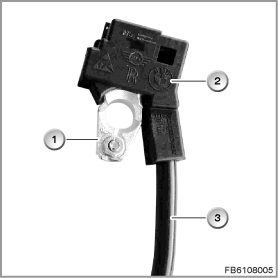
Index |
Explanation |
|---|---|
1 |
Battery negative terminal |
2 |
Intelligent battery sensor |
3 |
Negative battery lead |
For data transmission, the IBS is connected to the DME (Digital Motor Electronics) or DDE (Digital Diesel Electronics) via a Local Interconnect-Network bus (LIN bus).
Digital Motor Electronics (DME) or Digital Diesel Electronics (DDE)
Power management is carried out by the engine control module. Power management uses the information from the IBS.
Junction box electronics (JBE)
The JBE controls the bi-stable relay of terminal 30F at the request of the following components:
- Central gateway module (ZGM) for inhibited sleeping or unauthorized waking.
- Intelligent battery sensor (IBS) for closed-circuit current fault or reaching the starting capability limit.
System functions
The following system function is described for the power management:
- closed-circuit current monitoring
closed-circuit current monitoring
For closed-circuit current monitoring, a distinction is made between the following two cases:
- Idle state without auxiliary consumer units
- Idle state with logged in auxiliary consumer units
The IBS starts closed-circuit current monitoring 30 min after shutdown of terminal 30B.
Idle state without auxiliary consumer units
After the start of closed-circuit current monitoring, the IBS measures the closed-circuit current. If the threshold value of 80 mA is exceeded, the IBS registers a closed-circuit current fault.
If the discharge of the battery this causes is greater than 1 Ah, the following measures are run in succession as long as there is a closed-circuit current fault:
- Reset of terminal 30F: The IBS reports a closed-circuit current fault via the wake-up line to the junction box electronics and requests a reset of terminal 30F.
- Shutdown of terminal 30F: If there is still a closed-circuit current fault after resetting terminal 30F and reaching the idle state again, the IBS requests a shutdown of terminal 30F via the wake-up line to the JBE.
The power management stores a corresponding fault memory entry in the DME/DDE and after switching on terminal 15 again the following Check Control message displayed:
- Increased battery discharge.
The results of the last 24 closed-circuit current monitoring operations (value range of the closed-circuit current value and action carried out) are stored in the DME/DDE:
- Closed-circuit current value:
- 0-80 mA (normal closed-circuit current in the idle state)
- 80-200 mA
- 200-1000 mA
- Over 1000 mA
- 0-80 mA (normal closed-circuit current in the idle state)
- Requested action:
- No action (no closed-circuit current fault or caused discharge less than 1 Ah)
- Reset of terminal 30F
- Shutdown of terminal 30F
- No action but renewed closed-circuit current fault with terminal 30F switched off
- No action (no closed-circuit current fault or caused discharge less than 1 Ah)
Idle state with logged in auxiliary consumer unit
An auxiliary consumer unit is a consumer unit that can also be activated in the idle state of the vehicle can have closed-circuit current consumption outside of the nominal range:
- Telematic Control Unit (TCU): active telecommunications, active Telematic service.
- Automatic climate control (IHKA): independent ventilation, independent heating or residual-heat function.
- Automatic climate control (IHKA) or automatic rear climate control (FKA) After-run of internal temperature sensor fan.
- Electronic ride-height control (EHC): After-run of height control.
- Footwell module (FRM): Lighting function (e.g. parking lamps or side lamps).
The lighting function is a legally prescribed consumer unit.
All auxiliary consumer units must log onto the power management if they want to run a function in the idle state that requires closed-circuit current consumption greater than the target value. This is necessary to avoid misinterpretation in closed-circuit current monitoring.
After termination of the function, there must be a logoff.
If at least one auxiliary consumer unit is logged in, there is no closed-circuit current monitoring. In the idle state, the IBS then only monitors the battery charge state.
Depending on the battery charge state, the power management performs the following actions:
- Reaching the upper starting capability limit:
All auxiliary consumer unit except for the lighting function (relevant to safety) are requested to switch off.
The power management also requests shutdown of terminal 30B if it is still active. - Reaching the lower starting capability limit:
- If no lighting function is active, the power management requests a shutdown of terminal 30F.
- If the parking lamps or side lamps are active, there is no shutdown of terminal 30F. The parking lamps or side lamps are then switched off after a period of 12 h has elapsed after ”Terminal R off”.
- If the hazard warning flasher function is active, there is no shutdown of terminal 30F and the hazard warning flasher function.
- If no lighting function is active, the power management requests a shutdown of terminal 30F.
Notes for Service department
General information
Note! Troubleshooting only in the event of a closed-circuit current fault.
In the event of a problem with increased closed-circuit current, first of all check whether additional retrofitted current consumers (e.g. hands-free system, navigation device, device for enabling the TV function while the vehicle is being driven, cooler box, rodent repellant device, etc.) is connected to terminal 30, terminal 30F or directly to the battery. If necessary, ask the customer whether components have been retrofitted.
Then run an external closed-circuit current measurement and identify the possible cause (control modules connected to terminal 30 or terminal 30F) by restricting the distribution box and gradually removing fuses or disconnecting the corresponding control modules.
Procedure for external closed-circuit current measurement: See document ”Observing sleeping by means of external closed-circuit current measurement”.
Diagnosis instruction
Service function 'Evaluate closed-circuit current monitoring'
This service function can be used to read out the results of the last 24 closed-circuit current monitoring runs.