Power management
Advanced Power Management, APM
The power management a subsystem of the energy management. The power management is run from the engine control module (DME or DDE: Digital Motor Electronics or Digital Diesel Electronics).
While the vehicle is being driven, the power management regulates power consumption of some of the most important current consumers and the power output of the alternator as well as the battery charging.
Brief description of components
The following components for power supply are described:
- Battery
- Alternator
- Intelligent battery sensor
- Digital Motor Electronics or Digital Diesel Electronics
Battery
The capacity of the built-in battery depends on the engine used and the vehicle equipment. Selection criteria for the required capacity are:
- the cold-start characteristics of the engine
- the closed-circuit current consumption of the vehicle
- the energy requirement of the auxiliary consumer units (independent heating, telephone, etc.)
Alternator
With the engine running, the alternator generates a variable charge voltage for battery charging.
The variable charge voltage is influenced by the power management depending on the temperature and current by the DME/DDE raising the engine speed.
IBS: Intelligent battery sensor
The intelligent battery sensor (IBS) is a mechatronic component with its own microprocessor for monitoring the battery status. The IBS continuously measures the following values on the battery:
- Voltage
- Charge and discharge current
- Battery temperature
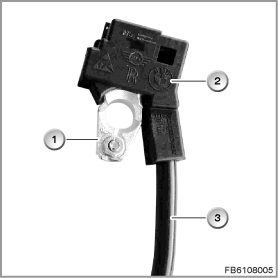
Index |
Explanation |
|---|---|
1 |
Battery negative terminal |
2 |
Intelligent battery sensor |
3 |
Negative battery lead |
For data transmission, the IBS is connected to the DME (Digital Motor Electronics) or DDE (Digital Diesel Electronics) via a Local Interconnect-Network bus (LIN bus).
DME or DDE: Digital Motor Electronics or Digital Diesel Electronics
The DME or DDE contribute to the power supply as follows: If the alternator voltage falls, DME/DDE increase the engine speed depending on the requirement. The software for this is called ”power management”.
System functions
The following system functions are described for power management (”Advanced Power Management”):
- Reduction or shutdown of individual current consumers
- Control of the electric auxiliary heater
- Increase in idle speed.
- Optimized charge voltage and vehicle voltage.
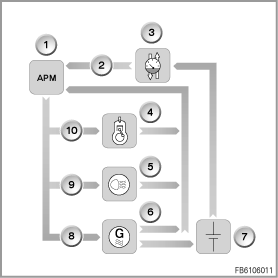
Index |
Explanation |
Index |
Explanation |
|---|---|---|---|
1 |
Advanced Power Management (APM) |
2 |
Data of the battery: |
3 |
Intelligent battery sensor (IBS) |
4 |
Engine |
5 |
Consumer units |
6 |
Alternator (G) |
7 |
Battery |
8 |
Specified target value for charge voltage |
9 |
Reduction of the power consumption or deactivation of individual current consumers |
10 |
Increase in idle speed |
Reduction or shutdown of individual current consumers
The shutdown of individual consumer units or reduction of the power consumption lowers the power consumption in critical situations. This means that the battery is not discharged.
The power management controls the shutdown of individual consumer units or reduction of the power consumption by means of requests (messages) to the control modules concerned.
With the engine running
With the engine running, individual functions are divided into two classes:
- Class A: A reduction in the power consumption or a shutdown of these consumer units is only perceived by the driver to a limited extent or after a delay.
A shutdown of individual class A consumer units or reduction in the power consumption is only activated under the following 2 conditions:- Battery charge state in the critical range
- High utilization of capacity of the alternator
- Battery charge state in the critical range
- Class B: A reduction in the power consumption or a shutdown of these functions is immediately perceived by the driver.
A shutdown of individual class B consumer units or reduction in the power consumption is only activated under the following condition:- Battery charge state in the critical range (close to the starting capability limit)
- Battery charge state in the critical range (close to the starting capability limit)
In the event of an engine shutdown (MSA)
To prevent excessive power consumption in the event of an engine shutdown (MSA), class A consumer units are restricted to the maximum reduction of power consumption and class B consumer units are only restricted to reduction no. 1 (see table below).
With the engine off and ignition switched on
With the engine off and ignition switched on, consumer units are not switched off or their power consumption reduced.
Class A current consumers
Under the conditions described, the following actions for class A consumer units are executed in succession:
No. |
Function |
Operation |
Control module |
|---|---|---|---|
1 |
Heated rear window (demister) |
Cyclic switching |
IHKA |
2
|
Rear seat heater |
Level 2 |
Rear seat modules or JBE |
Rear electric auxiliary heater |
75 % |
FKA |
|
3
|
Seat heating, front |
Level 2 |
Front seat module or JBE |
Rear seat heater |
50 % |
Rear seat modules or JBE |
|
4 |
Rear electric auxiliary heater |
50 % |
FKA |
5
|
Seat heating, front |
50 % |
Front seat modules or JBE |
Rear seat heater |
Stage 1 |
Rear seat modules or JBE |
|
6
|
Rear electric auxiliary heater |
25 % |
FKA |
Steering wheel heater |
50 % |
SZL |
|
7
|
Rear electric auxiliary heater |
OFF |
FKA |
Mirror heating |
OFF |
JBE or FRM |
|
Washer-nozzle heating |
OFF |
JBE |
|
8 |
Steering wheel heater |
OFF |
SZL |
9
|
Seat heating, front |
OFF |
Front seat modules or JBE |
Rear seat heater |
OFF |
Rear seat modules or JBE |
|
10
|
Heated rear window (demister) |
OFF |
IHKA |
Top-hifi system or BMW Individual High End audio system |
Max. 30 A current consumption after engine start |
AMPT |
Class B current consumers
Under the conditions described, the following actions for class B consumer units are executed in succession:
No. |
Function |
Operation |
Control module |
|---|---|---|---|
1
|
Top-hifi system or BMW Individual High End audio system |
Max. 30 A current consumption |
AMPT |
Heater blower, front and rear |
75 % |
IHKA, HKA or FKA |
|
2 |
Heater blower, front and rear |
50 % |
IHKA, HKA or FKA |
3 |
Heater blower, front and rear |
25 % |
IHKA, HKA or FKA |
When the battery charge state moves out of the critical range, the functions are then 100 % available.
Important!
When the shutdown of individual consumer units or the reduction of power consumption is activated, the displays remains active (LEDs remain lit).
Control of the electric auxiliary heater
On vehicles with diesel engines and without independent heating, the heat exchanger for the heating system is heated additionally with an electric auxiliary heater based on the PTC principle. The electric auxiliary heater is one of the consumer units that need a relatively high amount of power (up to 1300 W) and it is thus regulated by power management. Furthermore, two other electric auxiliary heaters (300 W each) are used in the rear on vehicles with rear climate control. These high electrical loads are regulated as follows:
- The IHKA control module controls the electric auxiliary heater (via LIN bus) and the FKA control module controls both electric auxiliary heaters in the rear (with a pulse-width modulated signal).
- The power management in the DDE regulates the maximum electrical power output of the electric auxiliary heater (signal in a CAN message).
The maximum power output of the electric auxiliary heater depends on the utilization of the alternator. - The electric auxiliary heater regulates the heat output of the heating register depending on the specifications of the power management.
Increase in idle speed
To prevent a negative charge balance of the battery, the power management can request an increase in the idle speed of the combustion engine. Depending on the engine variant, the idle speed is raised by up to 200 rpm. An idle-speed increase is activated under the following conditions:
- Quality of the calculated battery charge state adequate and battery charge state below a specified limit.
- High utilization of capacity of the alternator for a certain duration.
Optimal charge and vehicle voltage
Vehicles without intelligent alternator control (IGR)
The power management regulates the alternator voltage depending on the following criteria:
- Battery temperature: A cold battery loads less current, so the charging voltage should be higher than for a warm battery.
The temperature of the battery is determined by the IBS and sent to the DME or DDE across the LIN bus. - Protection of the battery against sustained excessive voltage and sustained discharge in the case of a poor state of charge.
- Request from components of the vehicle network and functions (e.g. exterior lighting or Dynamic Stability Control): minimum or maximum necessary voltage. These limit values must not be undershot or exceeded, as otherwise there can be function limitations or function failures.
This rule is to ensure adequate charge of the battery. The aim is a charge of 100 %.
Vehicles with intelligent alternator control (IGR)
In contrast to normal control of the battery charging, in the case of the intelligent alternator control a 100 % charge of the battery is avoided. The charge of the battery goes up to a range around 75 - 85 % of the maximum possible charge.
This means the battery can still 'accept power' to enable energy recuperation in the coasting phases of the vehicle.
The power management co-ordinates the various requirements for the vehicle voltage:
- Battery: Specified voltage dependent on the temperature of the battery. Minimum and maximum voltage for protection against sustained excessive voltage and discharge with poor state of charge.
The intelligent alternator control is suppressed in cycles and 100 % battery charge permitted to achieve full capacity of the battery for a sustained period (regeneration). - Components of the vehicle network and functions (e.g. exterior lighting or Dynamic Stability Control): minimum or maximum necessary voltage. These limit values must not be undershot or exceeded, as otherwise there can be function limitations or function failures.
- Operating status of the IGR: Energy recuperation in the coasting phases, partial alternator relief (no battery discharge permitted) or alternator relief (return of the energy from the battery into the vehicle network).
Notes for Service department
General information
Note! Procedure in the event of a customer complaint with regard to malfunctions
In the event of customer complaints with regard to malfunctions related to the reduction in power consumption or shutdown of individual current consumers, use the following procedure:
- Run the test module ”Reduction of current consumers”. Information on the reduction or shutdown (point in time, duration and functions concerned) is shown in the test module.
- Check the function with activation via diagnosis (component activation or test module for function check).
- If appropriate, inform the customer regarding the situation.