Intelligent battery sensor and battery
Brief description of components
The following components are described:
- Battery
- Intelligent battery sensor
Battery
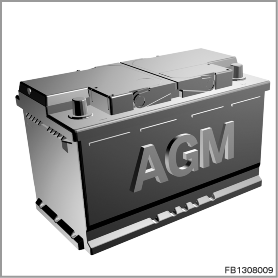
The vehicle battery is fitted in the centre at the rear of the base of the luggage compartment. In the F01/F02, an AGM battery (recognizable by the black housing) is always fitted. The AGM battery has a capacity of 90 Ah.
The AGM battery provides above all the advantage of higher cycle resistance.
IBS: Intelligent battery sensor
The IBS is a mechatronic, intelligent battery sensor with its own microprocessor. The microprocessor is a component of the electronic module. The electronic module is used to detect the voltage, the current flowing and the temperature of the battery.
The following components are fitted in the electronic module:
- a shunt (resistor for current measurement)
- a temperature sensor
- electronic evaluation unit on a board
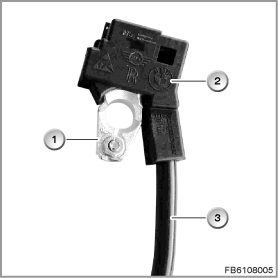
Index |
Explanation |
|---|---|
1 |
Battery negative terminal |
2 |
Intelligent battery sensor |
3 |
Negative battery lead |
The IBS continuously measures the following values on the battery:
- Terminal voltage
- Charge current
- Discharge current
- Temperature of the battery
For data transmission, the IBS is connected to the DME (Digital Motor Electronics) or DDE (Digital Diesel Electronics) via a Local Interconnect-Network bus (LIN bus).
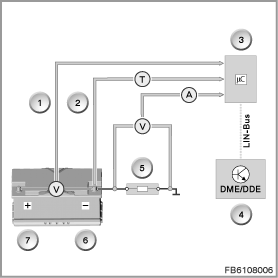
Index |
Explanation |
Index |
Explanation |
|---|---|---|---|
1 |
Measurement of the battery voltage between the positive battery terminal and negative battery terminal |
2 |
Temperature measurement of the battery (T) |
3 |
Microprocessor (C) in the intelligent battery sensor (IBS) |
4 |
Digital Motor Electronics (DME) or Digital Diesel Electronics (DDE) |
5 |
Current measurement (A) [indirect, via the proportionally voltage drop (V) at the measuring resistor (shunt)] |
6 |
Negative battery terminal |
7 |
Positive battery terminal |
|
|
LIN bus |
Local Interconnect Network bus (LIN bus) for transmission of the values to the DME or DDE |
|
|
System functions
The following system function of the power management with IBS (”Advanced Power Management”) is described:
- Determining the battery charge state
Battery charge condition
The APM with the intelligent battery sensor determines the battery charge state while the vehicle is being driven and when the vehicle is at a standstill on the basis of measurement data:
- Vehicle being driven:
- Balancing the charge and discharge current of the battery.
- Calculation of the current characteristics on engine start to ascertain the battery condition.
- Balancing the charge and discharge current of the battery.
- Vehicle at a standstill
When the vehicle is at a standstill, the measured values (open-circuit voltage measurement) are queried in cycles to detect energy losses. The measured values are entered in the IBS in the memory and transferred to the DME/DDE after restarting the engine.
For the history of the battery charge state, the following values are stored in the DME/DDE:
- Battery charge state of the last 5 days.
- Charge state histogram with duration in the ranges 0 - 20 %, 20 - 40 %, 40 - 60 %, 60 - 80 % and 80 - 100 %.
The charge state histogram is reset in the following cases: programming the DME/DDE or registering a battery replacement.
Note! Evaluation of the battery charge state.
If the off-load phase is not sufficiently long or if there is a closed-circuit current fault, the battery charge state cannot be determined correctly: the state of charge is implausible.
Starting capability limit
APM calculates a lower and upper starting capability limit for the battery:
- The lower starting capability limit corresponds to the minimum charge state of the battery so that the vehicle can still be started.
- To counteract discharge down to the lower starting capability limit, a certain charge volume is kept as a reserve. To achieve this, the upper starting capability limit is calculated. This value is used e.g. as the limit value for the requests for deactivation of terminal 30B when auxiliary consumer units are active.
The starting capability limit is calculated by evaluating the following measured variables:
- Average battery temperature with vehicle parked.
- Ambient temperature of the last journey.
- Current state of charge.
- Voltage dip of the last engine start (trend for ageing of the battery).
Notes for Service department
General information
The following general data is provided:
- Assessment of the battery condition.
- Charging and trickle charging of the battery.
- Replacing the intelligent battery sensor (IBS).
Note! Assessment of the battery condition.
The battery condition cannot be determines solely on the basis of the battery charge state.
All batteries are subject to natural wear in the normal aging process: The chemical reactions in the battery, consisting of the charge cycles with battery charging and discharging, mean that deposits form in the battery, preventing the battery from reaching full capacity.
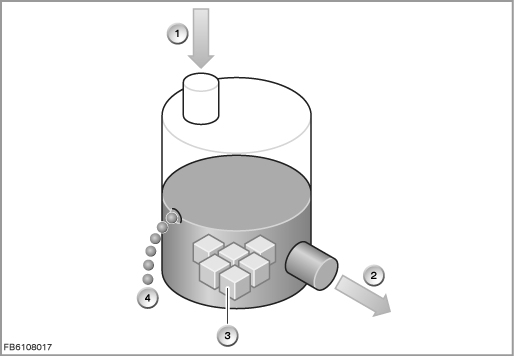
Index |
Explanation |
Index |
Explanation |
|---|---|---|---|
1 |
Charge battery. |
2 |
Battery discharged. |
3 |
Ageing / deposits |
4 |
Self-discharging. |
If you suspect that the battery is damaged, check the battery condition with a battery tester and examine the cause by means of the test module 'Energy diagnosis'. If the battery charge level is low, recharge the battery prior to handing over the vehicle to the customer.
Note! Charging and trickle charging of the battery.
The battery may only be charged using the BMW-approved chargers at a constant charge voltage of 14.8 V.
If possible, the battery temperature during charging should be between 15 °C and 25 °C. Under these conditions, the battery is adequate charged if the charge current has fallen below 2.5 A.
If the charging process is carried out at low temperatures, it is only to be terminated after the charge current falls short of 1.5 A.
If the battery is charged when fitted, the charging process must take place via the starting-aid terminal. This is the only way to ensure that the charging process is detected correctly by the vehicle electronics on vehicles with an intelligent battery sensor (IBS).
If the battery is charged directly at the battery terminals, misinterpretations of the battery status and, under certain circumstances, unwanted Check Control messages or fault memory entries can occur.
The cigarette lighter is supplied with voltage by the front distribution box via switched terminal 30B. After terminal 30B off, the relay de-energizes. This means that a trickle charger connected at the cigarette lighter would be disconnected from the battery. Only charge the battery via the starting-aid terminal.
Note! Replacing the IBS.
The vehicle with the new IBS must be placed in the idle state for at least 3 hours: Only then can the new IBS determine the battery status.
The Check Control message 'battery severely depleted' is then no longer displayed if the battery is adequately charged and the correct battery charge state can be displayed.
Diagnosis instructions
Note! Register battery change.
After fitting a new battery, the service function 'Register battery replacement' should be run. Registration of the battery replacement is necessary to notify the power management that a new battery has been fitted in the vehicle.
Without registration of the battery replacement, the power management does not run properly and this can lead to Check Control messages and function limitations, for example reduction or deactivation of individual consumer units.