LIN bus
The LIN bus is a sub-bus and means: Local Interconnect Network bus.
The Local Interconnect Network bus (LIN bus) is a serial single-wire bus standardized for the automobile industry. The Local Interconnect Network bus (LIN bus) is used mainly in the combination of master controller and slave. The purpose of the LIN bus is to ensure rapid and reliable communication between the master control module and slave.
In the new vehicle networks, the application of the LIN bus system has been extended to a significant degree.
Brief description of components
Main buses are responsible for the inter-system data exchange between the control modules. These also include the system functions diagnosis, programming and encoding.
Sub-bus systems interchange data within a function group. For example, the data of the intelligent battery sensor or of the combustion preheating control module are read by the engine management system (Digital Motor Electronics or Digital Diesel Electronics).
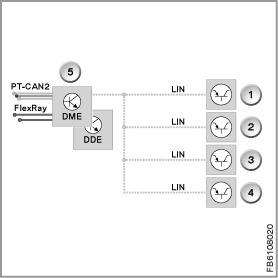
Engine management system (DME or DDE) as an example
Index |
Explanation |
Index |
Explanation |
|---|---|---|---|
1 |
Active air flap control |
2 |
Intelligent battery sensor |
3 |
Combustion preheating control module |
4 |
Coolant pump for intercooler |
5 |
Engine management system |
|
|
Other examples are:
- Connection of footwell module to the switch block in the driver's door and the exterior mirrors
- Connection from the roof function centre to the rain-light-solar-condensation sensor
- Connection from automatic air-conditioning system to the 15 actuator motors
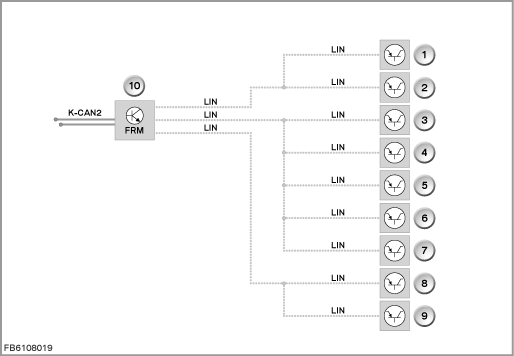
Footwell module (FRM) as an example
Index |
Explanation |
Index |
Explanation |
|---|---|---|---|
1 |
Operating unit, light |
2 |
Driver assistance system operating unit |
3 |
Driver's side door mirror |
4 |
Exterior mirror on passenger's side |
5 |
Switch block for seat adjustment on driver's side |
6 |
Switch block for seat adjustment on passenger's side |
7 |
Switch block, driver's door |
8 |
Headlamp driver module, left |
9 |
Headlamp driver module, right |
10 |
Footwell module (FRM) |
In all cases, only one master control module is installed in a LIN bus system. A maximum of up to 16 participants (so-called slaves) may be connected. There is no prescribed bus structure. The maximum cable length for a LIN bus is limited to 40 metres. The data transfer rate of the LIN ranges from 2.4 to 19.2 kBit/s. The low data transfer rate means that termination is not absolutely necessary.
System function
The LIN bus is synchronized at the start of each message sent by the master controller. This means there is a so-called ”self-synchronization” of the bus without clocking quartz crystal.
Components on the LIN bus that match the specification data protocol LIN V2.0 or higher have extended functions.
- The components for V2.x are delivered with a device ID and a base configuration. The final (dynamic) configuration and the allocation of the identification number take place during commissioning by the master control module.
- The data protocol has become more variable. From specification V2.0 or higher, if required, both periodical and sporadic messages are permitted.
- The master control modules can send so-called multiple requests to a group of slaves. To reduce the bus load, the slaves only respond if values have changed (e.g. door contact).
Notes for Service department
General information
All master control modules of the specification LIN V2.0 and higher are downwardly compatible to components of existing specifications. However, all V2.0 slaves also require a V2.0 master control module and higher.
Diagnosis instructions
The active air flap control is connected via LIN bus to the engine management system.
In the case of conversions to a sports package, the active air flap control is removed permanently. In this case, a service function for the DDE has to be run.
No liability can be accepted for printing or other faults. Subject to changes of a technical nature