Pedestrian protection
Pedestrian protection
The pedestrian protection system has the task of detecting an accident situation between a passenger car and a pedestrian in the area of the bonnet and of selectively activating the system depending on certain marginal conditions.
The pedestrian protection is a complete system consisting of pedestrian protection sensors, control module and actuators.
Brief description of components
The following components are described for the pedestrian protection system:
Crash Safety module
The crash safety module (ACSM) evaluates the signals of the pedestrian protection sensor. ”ACSM” stands for ”Advanced Crash Safety Module”.
If a collision with a pedestrian is registered by the pedestrian protection sensors, the crash safety module always triggers all actuators for the pedestrian protection.
Pedestrian protection only triggers within a defined road speed range. Outside of the defined road speed range, the function is blocked in the crash safety module.
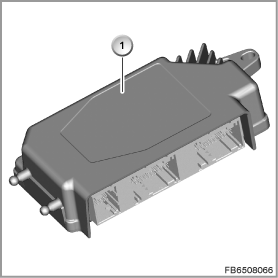
Index |
Explanation |
Index |
Explanation |
|---|---|---|---|
1 |
Crash safety module (ACSM) |
|
|
Pedestrian sensors
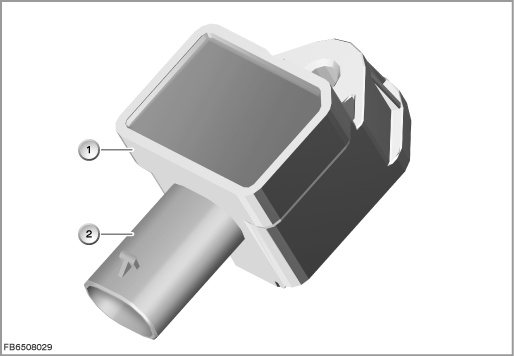
A number of pedestrian protection sensors are installed in the bumper. The right pedestrian protection sensor is supplemented by the center pedestrian protection sensor and the left pedestrian protection sensor. All the sensors are identical components.
The pedestrian protection sensor is an acceleration sensor. The acceleration values picked up by the micro-mechanical acceleration sensor are converted into digital signals and sent in cycles to the crash safety module.
Index |
Explanation |
Index |
Explanation |
|---|---|---|---|
1 |
Pedestrian protection sensor |
2 |
2-pin plug-in connection |
Actuators
The following actuators are described for the pedestrian protection system:
Pedestrian protection actuator at the front left and pedestrian protection actuator on the right
If the crash safety module sends a trigger signal, the actuators trigger as follows:
The priming cap in the pyrotechnic component ignites the propellant charge.
The pyrotechnic actuator contains a priming cap whose propellant charge shifts a plunger with bolt to unlock the bonnet catch.
After this unlocking, the bonnet is raised at the front left bonnet catch by the force of the springs within a few milliseconds by 30 millimetres. The triggering spring is integrated in the bonnet catch.
- Front left actuator for pedestrian protection
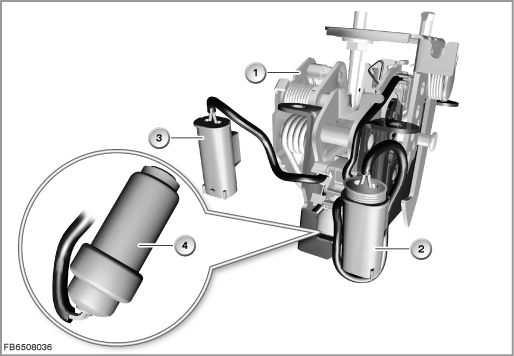
The actuator is installed in the front left bonnet catch.
Index |
Explanation |
Index |
Explanation |
|---|---|---|---|
1 |
Front-left bonnet catch with integrated front left actuator for pedestrian protection |
2 |
Plug-in connection for bonnet contact switch |
3 |
Plug-in connection for pyrotechnical component |
4 |
Pyrotechnical component (contains priming cap, propellant charge and plunger with bolt to activate the mechanical release) |
- Front right actuator for pedestrian protection
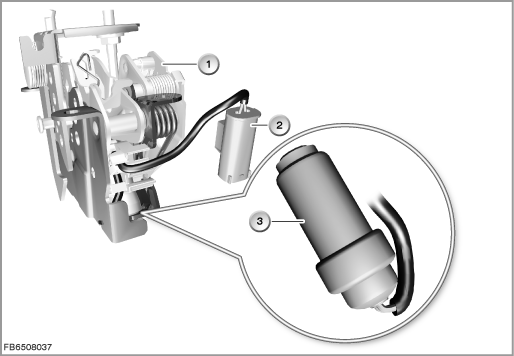
The actuator is installed in the front right bonnet catch.
Index |
Explanation |
Index |
Explanation |
|---|---|---|---|
1 |
Front right bonnet catch with integrated front left actuator for pedestrian protection |
2 |
Plug-in connection for pyrotechnical component |
3 |
Pyrotechnical component (contains priming cap, propellant charge and plunger with bolt to activate the mechanical release) |
|
|
Actuator for pedestrian protection at the rear left and actuator for pedestrian protection at the rear right
If the crash safety module sends a trigger signal, the actuators trigger as follows:
The priming cap in the pyrotechnic component ignites the propellant charge.
The pyrotechnic actuator contains a priming cap whose propellant charge unlocks the two locking pins in the lid.
After this unlocking, the bonnet is raised by the force of the springs in the actuator within a few milliseconds by 50 millimetres.
- Rear left actuator for pedestrian protection
The actuator is installed in the rear left bonnet hinge.
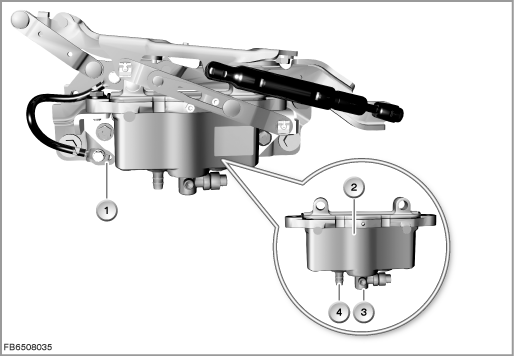
Index |
Explanation |
Index |
Explanation |
|---|---|---|---|
1 |
Rear-left bonnet hinge |
2 |
Rear left actuator for pedestrian protection |
3 |
Pyrotechnical component (contains priming cap, propellant charge and mechanical system for activating the locking pins) |
4 |
Condensate drainage |
- Rear right actuator for pedestrian protection
The actuator is installed in the rear right bonnet hinge.
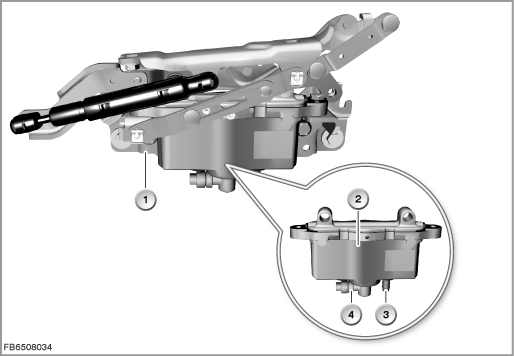
Index |
Explanation |
Index |
Explanation |
|---|---|---|---|
1 |
Rear-right bonnet hinge |
2 |
Rear right actuator for pedestrian protection |
3 |
Condensate drainage |
4 |
Pyrotechnical component (contains priming cap, propellant charge and mechanical system for activating the locking pins) |
System functions
The following system functions are described for the pedestrian protection system:
Functional networking
The following illustration shows the functional networking for the pedestrian protection system.
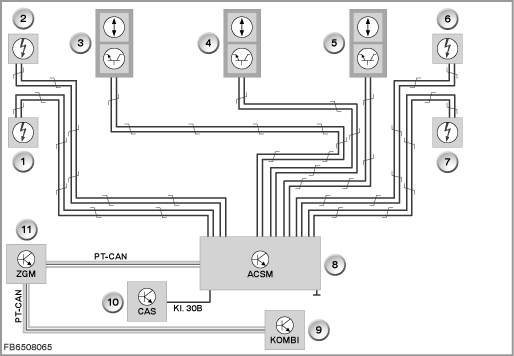
Index |
Explanation |
Index |
Explanation |
|---|---|---|---|
1 |
Rear left actuator for pedestrian protection |
2 |
Front left actuator for pedestrian protection |
3 |
Left pedestrian protection sensor |
4 |
Center pedestrian protection sensor |
5 |
Right pedestrian protection sensor |
6 |
Front right actuator for pedestrian protection |
7 |
Rear right actuator for pedestrian protection |
8 |
Crash safety module (ACSM) |
9 |
Instrument cluster (KOMBI) |
10 |
Car Access System (CAS) |
11 |
Central gateway module (ZGM) |
|
|
Terminal 30B |
Terminal 30B, base operation |
PT-CAN |
Powertrain CAN |
System activation
If a collision with a pedestrian is registered by the pedestrian protection sensors, the crash safety module always triggers all the actuators for pedestrian protection.
This triggering is pyrotechnical. Subsequently, a spring force raises the bonnet by 30 mm at the front and 50 mm at the rear.
This enlarges the space between the inner panel of the engine and the attachments on the engine as well as on the body. The enlarged space increases the possible deformable area of the bonnet in the event of a head impact. Furthermore, the rigid connection of the engine is changed into an elastic connection by the springs in the actuators.
This enables improved energy dissipation when the head strikes the bonnet.
After the system has been triggered by a sensor signal, the bonnet can be reset.
Overpressing the opened bonnet (towards open) mechanically locks the rear actuators in the bonnet hinge, that is, the locking pins in the lid catch securely in the housing part of the actuator, as the spring force causes the mechanical system in the pyrotechnic component to return to its original position (same as before triggering).
The actuators in the front bonnet catches are automatically reset after opening and subsequently closing the bonnet.
Notes for Service department
General information
After the pedestrian protection system has triggered, it is obligatory to replace the actuators for renewed activation of the system. The triggering has used up the priming cap and propellant charge in the pyrotechnic components.
No liability can be accepted for printing or other faults. Subject to changes of a technical nature