Active cruise control with Stop&Go function
Active cruise control with Stop&Go function
In some markets, ACC is offered without the Stop&Go function due to approval restrictions.
In the case of ACC without Stop&Go function, no short-range sensors are fitted.
Notes for Service department
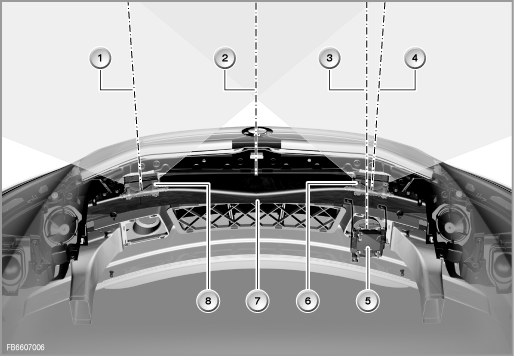
Index |
Explanation |
Index |
Explanation |
|---|---|---|---|
1 |
Centre axis of the short-range sensor, left |
2 |
Vehicle longitudinal axis |
3 |
Centre axis of the long-range sensor |
4 |
Centre axis of the short-range sensor, right |
5 |
Long-range sensor with bracket |
6 |
Short-range sensor, right, with bracket |
7 |
Bumper carrier |
8 |
Short-range sensor, left, with bracket |
Observe the following information in Service:
- The diagnosis of the long-range sensor (LRR) takes place via the ICM control module. The ICM control module is thus the gateway for the LRR control module. If the ICM control module is defective or not connected, no LRR diagnosis can be carried out: the control module does not respond.
- After replacement, the ICM control module must be recoded.
- The long-range sensor must be recoded after it has been replaced.
- The short range sensors are automatically coded via the assignment of pins of the connector (no separate encoding after replacement of a short-range sensor).
- After replacement of the long-range sensor, this must be readjusted. Use the corresponding service function.
- On replacement of a short-range sensor, observe the exact installation location: in accordance with the repair instructions. A setting similar to that for the long-range sensor is not necessary. Instead, the installation angle of the sensor must be stored again in the ICM control module: Use the corresponding service function.
Introduction
The following text describes the active cruise control with Stop&Go function (optional extra 5DF).
Active cruise control with the Stop&Go function has been available since 2007 in the 5 Series and 6 Series.
As a supplement to the familiar active cruise control, the Stop&Go function enables:
- Distance and cruise control up to a standstill through engine or brake intervention
- Automatic driving off from a standstill after a short parking period (1 to 3 seconds)
- Adaptive brake assist
The required speed can be selected in the range from 30 km/h to 180 km/h: in convenient steps of 10 or fine steps of 1. The required speed is displayed in the instrument cluster. Furthermore, it is also possible to choose between 4 distances.
Brief description of components
The following components are described for ACC:
Short-range sensor, left and right
The short-range sensors are radar sensors (Short Range Radar).
For the ACC with Stop&Go function, 2 identical short-range sensors have been installed. The short-range sensors are mounted on the front bumper bracket with a bracket made of plastic.
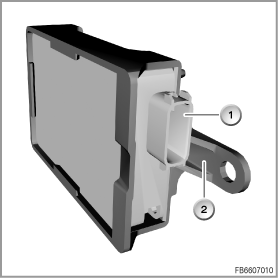
Index |
Explanation |
Index |
Explanation |
|---|---|---|---|
1 |
Short-range sensor |
2 |
Bracket |
The short-range sensors are connected via the sensor CAN (S-CAN) with the ICM control module.
The short-range sensors have the following task:
- Calculating position and movement data
- Sensing objects in the short range up to 30 metres ahead of the vehicle
The object data of the short-range sensors is only used for the ACC Stop&Go function (not for adaptive brake assist).
LRR: long-range sensor
LRR stands for Long Range Radar.
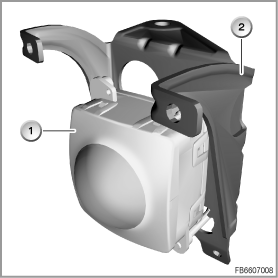
Index |
Explanation |
Index |
Explanation |
|---|---|---|---|
1 |
long-range sensor |
2 |
Bracket |
The long-range sensor (former ACC sensor) is a radar sensor. At the same time, the long-range sensor is a control module. This means the long-range sensor has a control module address and can be diagnosed and programmed.
A long-range sensor senses the distance, angle as well as speed of moving objects. The area covered is up to 150 metres ahead of the vehicle. These data are processed in the ICM control module.
ICM: Integrated Chassis Management
The ICM control module is installed in the centre console on the transmission tunnel.
Index |
Explanation |
Index |
Explanation |
|---|---|---|---|
1 |
Device carrier |
2 |
LDM control module |
For ACC with Stop&Go function, the ICM control module performs the following tasks:
- Collating the data transferred by the radar sensor regarding objects
- Evaluating the objects and selecting the object relevant to distance control
- Evaluating the control signals and generating display signals
- Regulating speed and distance
- Generating and sending the target values to the actuators drive and brake via the FlexRay
- Monitoring all input signals, the control module (hardware) as well as the vehicle response characteristics for faults or implausible states
S-CAN: sensor CAN
The sensor CAN (S-CAN) connects:
- the ICM control module
- the long-range sensor (LRR)
- the short-range sensors
System functions
The following system functions are described:
- Functional networking
- Adaptive brake assist
- Unexpected system behaviour
Functional networking
For implementation of the Stop&Go function, a complex composite system with distributed functions in other control modules is necessary. The ICM control module is connected across data buses with these other control modules.
The following control modules are networked for the overall function:
Control module |
Function |
|---|---|
DME or DDE: Engine management system |
Implementation of the torque request ”Engine on” signal |
DSC: Dynamic Stability Control |
Driving situation Implementation of the brake intervention |
SZL: Steering column switch cluster |
Operating lever Steering angle |
CIC: Navigation system |
Data from navigation system (influence on control variables) |
KOMBI: Instrument cluster |
Diagram of the displays (ACC and Check Control messages) |
CAS: Car Access System |
Terminal status and wake-up line Door contact |
EGS: transmission control |
Drive position |
AHM: Trailer module |
Detection of trailer towing |
ACSM. Crash Safety module |
Driver's seat occupancy (driver intends to exit) Seat belt buckle contact (driver intends to exit) |
RLS: Rain / driving light sensor |
Road surface condition (wet) |
FRM: Footwell module |
Activation of hazard warning lights |
Adaptive brake assist
The adaptive brake assist is a function of the ICM. The adaptive brake assist is only available on vehicles with active cruise control with Stop&Go function.
The adaptive brake assist provides its greatest benefit in emergency braking situations. If the driver of the vehicle ahead brakes suddenly, the long-range sensor detects this situation.
The brake assist supports the driver in optimizing the brake operation, preventing a run-up collision in the best case.
The following functions are available:
- Pre-filling of the brake system
- Adaptation of a number of parameters for the braking functions in the DSC according to the situation
- Visual warning for the driver in the instrument cluster in the event of an advance warning
- Visual and acoustic warning for the driver in the event of an acute warning
The adaptive brake assist can be switched on using the corresponding button in the driver assistance control panel. The point in time of the advance warning can be selected using the button (2 stages possible).
The adaptive brake assist can also be switched on without activating the ACC Stop&Go function.
Unexpected system behaviour
A situation that requires explaining to the driver may occur if the function limits of the ACC system are reached. Such situations are described in the following:
- Great differences in speed between the vehicle and the vehicle in front cannot be regulated by the system. In this case, brake intervention on the part of the driver is necessary.
- The active cruise control does not react to stationary traffic obstructions or oncoming traffic.
- The distance control is limited by the detection range of the radar sensors: in the event that vehicles cut in very closely and quickly in front of the vehicle, intervention on the part of the driver can be necessary.
- The leading vehicle may be lost when cornering due to the limited side field of vision of the radar sensors. In this case, the acceleration to the required speed is briefly suppressed.
Reason: this will prevent the vehicle from accelerating too close to the vehicle ahead, which is possibly only briefly not being monitored. - If the radar sensors are ”blinded”, for example by heavy snow, the ACC switches off. A Check Control message is output to the driver. The ACC can be reactivated after cleaning the radar sensors.
Important: Multiple layers of paint on the bumper in the area of the short-range sensors can also ”blind” the short-range sensors. - If ASC or DSC intervene for longer periods (with critical coefficients of friction), ACC switches off.
- Rain, fog and snow absorb the radar beams. This can significantly reduce the range of ACC. In extreme cases, ACC can no longer be used.
- Brows of hills and depressions may obstruct detection, causing objects to be lost.
- In very rare cases, objects can be sensed with incorrect measured values (usually the angle). For example, due to reflection of the radar beams from tunnel walls and guarding rails.
No liability can be accepted for printing or other faults. Subject to changes of a technical nature