Seat occupancy detection, passenger side
Seat occupancy detection, passenger side
The passenger seat occupancy detection recognizes whether the seat is occupied or not.
The design of the seat occupancy detection depends on the national version.
- Passenger seat occupancy detection, Europe version:
The seat occupancy detection is only used for the seat belt warning.
If the front passenger's seat is detected as occupied via the seat occupancy mat, the passenger belt must also be inserted into the belt buckle. The seat belt warning then goes out.
If the crash safety module triggers the airbags, the corresponding airbags on the passenger's side are also triggered even if the passenger's seat is unoccupied. - Passenger seat occupancy detection, US version:
In accordance with the stipulations of the National Highway Traffic Safety Administration (NHTSA) a small child in a child restraint system on the passenger's seat must be automatically detected. On detection, the airbags on the passenger's side are automatically disabled. The indicator lamp for the passenger's airbag deactivation lights up.
Functional description
- Passenger seat occupancy detection, Europe version:
When a weight is placed on the seat, resistance in the seat occupancy mat changes. The seat occupancy electronics evaluate this change in resistance (”seat occupied” or ”seat unoccupied” status).
The signal is sent to the crash safety module via a direct wire.
The seat is recognized as being not occupied up to a weight of approx. 12 kg. The seat occupancy detection function, however, also depends on the type of seat.
For example: The material tension in a leather seat or a taut sports seat is already interpreted as pressure on the sensors. In such cases, a weight below 12 kg can trigger the ”seat occupied” condition.
Persons can only be detected correctly if they assume the correct seating position, as both halves of the seat have to be loaded simultaneously.
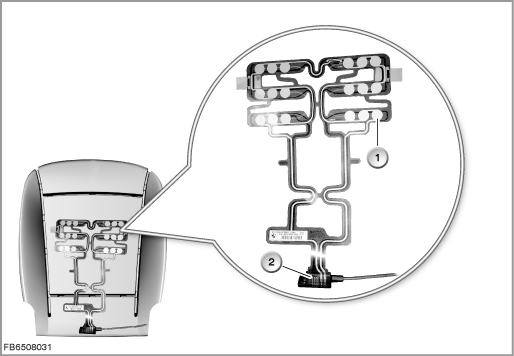
Index |
Explanation |
Index |
Explanation |
|---|---|---|---|
1 |
seat occupancy mat with pressure sensors |
2 |
Electronic module |
- Passenger seat occupancy detection, US version:
The crash safety module detects the seat occupancy status by evaluating the imprint on the passenger's side seat cushion.
This enables the crash safety module to decide whether to enable and disable the airbags on the passenger's side.
The distances between the surfaces and centres of gravity of the occupied seat cushions indicate whether a person of adequate size (adolescent / adult) or a child in the child restraint system specifically designed for the purpose is involved.
If a small child is detected, the airbags on the passenger's side are automatically disabled. The indicator lamp for passenger's airbag deactivation lights up.
If a person of adequate size sitting correctly (adolescent / adult) is detected, the airbags on the passenger's side are activated. The indicator lamp for passenger's airbag deactivation does not come on.
The passenger's airbag could deactivate with a youth or adult seated in certain positions (indicator lamp for passenger airbag deactivation comes on). In such cases, the seat position must be varied until the indicator lamp for passenger's airbag deactivation goes out (airbags activated).
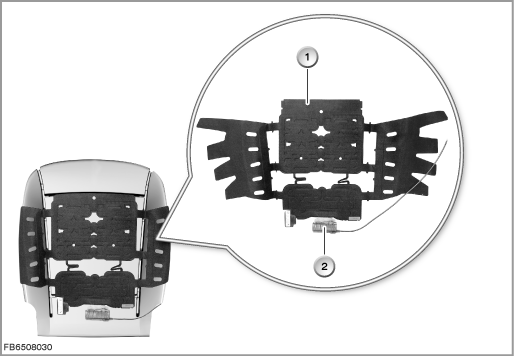
Index |
Explanation |
Index |
Explanation |
|---|---|---|---|
1 |
seat occupancy mat with pressure sensors |
2 |
Electronic module |
Structure and inner circuit
The passenger seat occupancy detection consists of:
- seat occupancy mat
- Electronic module
In the electronic module, the sensor signal are processed, converted into digital signals and sent in cycles to the crash safety module.
The data are sent across the LIN bus.
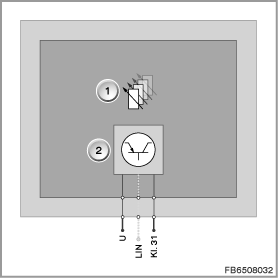
Index |
Explanation |
Index |
Explanation |
|---|---|---|---|
1 |
pressure sensors |
2 |
Electronic module |
Pin assignments
Pin |
Explanation |
|---|---|
U |
Power supply from the ACSM control module |
LIN |
LIN bus |
Kl. 31 |
Terminal 31 earth connection |
Target values
The seat occupancy mat is supplied with voltage by the crash safety module (ACSM). (ACSM stands for ”Advanced Crash Safety module”, referred to as the ”crash safety module”).
Observe the following target values for the seat occupancy mat:
Variable |
Value |
|---|---|
Voltage range |
7 to 16 V |
Current consumption in normal operating mode |
0.5 A |
Maximum current consumption (for 10 milliseconds) |
1 A |
Temperature range |
-40 to 85 °C |
Diagnosis instructions
Failure of the component:
If the passenger seat occupancy detection fails, the following behaviour is to be expected:
- Fault memory entry in the crash safety module
- Airbag warning lamp lights up
- The indicator lamp for passenger'S airbag deactivation (passenger airbag off lamp) lights up, only US version.
No liability can be accepted for printing or other faults. Subject to changes of a technical nature