Wheel electronics system, front right
Wheel electronics system, front right
The wheel electronics system is a component of the Tyre Pressure Monitor (RDC).
In all wheels, wheel electronics systems are installed in the wheel drop centre. The wheel electronics systems are bolted onto the filling valves (made of metal).
The wheel electronics systems are identical components.
The tyre pressure monitor is a system for monitoring the tyre pressure while the vehicle is being driven. It is offered exclusively in the USA (legal requirement) and as an optional extra in Canada.
At the request of the RDC control module (in cycles of 54 seconds), a message is queried via the RDC transmitters (125 kHz) by each wheel electronics system. The message is then sent across a high-frequency transmission path (433 MHz) to the RDC antenna.
Among other things, this message contains the following information:
- Tyre pressure
- Tyre air temperature
- Battery status of the wheel electronics system
- Identifier (ID)
The received radio signal are converted into a digital signal in the RDC antenna. This digital signal is forwarded on the bus to the RDC control module.
Functional description
The RDC control module sends a request to the RDC transmitters across the data line. In each RDC transmitter, the digital signal is converted into a radio signal. Subsequently, the RDC transmitters send the request telemetrically to the wheel electronics systems in the wheels.
For identification by the RDC control module, each wheel electronics system has its own ID (identifier). This ID is transferred with each data interchange.
The information of the acceleration sensor is evaluated for detection of the road wheel. The acceleration sensor is conceived in such a way that the rotation of the wheel is detected as of a certain tangential speed and the corresponding bit is set in the message of the wheel electronics system. In cases of doubt, the bit is used to distinguish between the road wheel and the spare wheel.
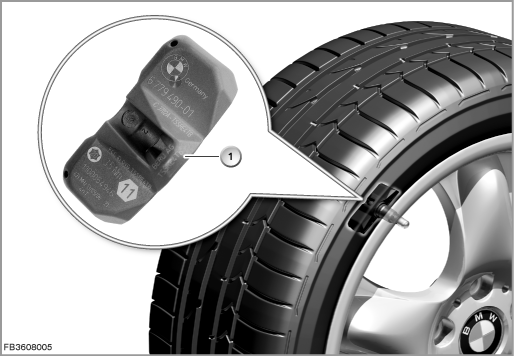
Index |
Explanation |
Index |
Explanation |
|---|---|---|---|
1 |
Wheel electronics system |
|
|
So as not to place an unnecessary load on the state of charge of the battery, the wheel electronics system works in 4 different modes. The mode in which a wheel electronics system runs a measurement or sends a radio signal depends on the tyre pressure and tyre air temperature.
- Mode 0
Transport mode for new wheel electronics systems
In the transport mode, the wheel electronics system is not active. The wheel electronics system is activated on initial fill of the tyre when for the first time overpressure of at least 1.5 bar is applied. - Mode 1
In this mode, slow pressure changes up to a tyre pressure loss of 0.2 bar are detected (e.g. natural tyre pressure loss due to diffusion).- The tyre pressure and tyre air temperature are measured every 3.4 seconds
- The information is sent every 54 seconds
- The tyre pressure and tyre air temperature are measured every 3.4 seconds
- Mode 2
At a tyre pressure loss of more than 0.2 bar compared to the last sent pressure reading, the wheel electronics system switches immediately into the fastest mode.- The tyre pressure and tyre air temperature are measured every 0.8 seconds
- The information is sent every 0.8 seconds
- Warning as of 0.2 bar tyre pressure loss by RDC, warning lamp and Check Control message
- Warning as of 20 % tyre pressure loss by RDC, warning lamp, Check Control message and acoustic signal
- The tyre pressure and tyre air temperature are measured every 0.8 seconds
- Mode 3
In the case of temperature values greater than 120 °C inside the tyre, the wheel electronic system is switched off; if it cools down to less than 110 °C, it is switched on again.- No measurement
- The information is sent every 54 seconds
- No measurement
Structure and inner circuit
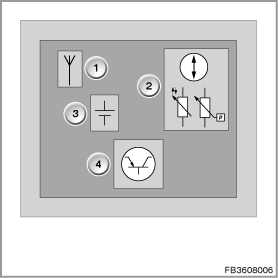
The wheel electronics system consists of a plastic housing. The plastic housing contains a circuit board and the following components:
- Pressure sensor
- Temperature sensor
- Acceleration sensor
- Transmitter/receiver unit
- Electronic evaluation unit
- Battery
Index |
Explanation |
Index |
Explanation |
|---|---|---|---|
1 |
Antenna with transmit and receive unit |
2 |
Pressure, temperature and acceleration sensors |
3 |
Battery |
4 |
Electronic evaluation unit |
Target values
Observe the following target values for the wheel electronics systems:
Variable |
Value |
|---|---|
Battery system (lithium-thionylchloride) |
3.6 V |
Service life of the battery |
approx. 7 years. |
Measuring tyre pressure, tyre air temperature and battery status of the wheel electronics system |
Mode 1: Mode 2 or 3: |
Sending all data |
Mode 1: Mode 2 or 3: |
Dwell time |
Mode 2 or 3: |
Transmission frequency, version 1 (basic version) |
433 MHz |
Transmission frequency, version 2 (depending on model series and national version) |
315 MHz |
Reception frequency |
125 ± 6 kHz |
Temperature range |
-40 to 120 °C |
max. operating temperature |
150 °C for max. 10 minutes |
Centrifugal acceleration |
max. 2000 g |
Diagnosis instructions
Failure of the component:
If the wheel electronics system fails, the following behaviour is to be expected:
- Fault memory entry in the RDC control module
- Check Control message
- The RDC indicator and warning light lights up
Note: Deactivating an activated wheel electronics system is not possible.
It is not possible to deactivate a wheel electronics system that has already been activated. However, it does not send a radio signal as long as it has not been activated (trigger signal from RDC transmitter) and the vehicle is at a standstill.
The state of charge as well as the residual runtime of the battery in the wheel electronics system can be shown in the BMW diagnosis system.
The battery of the wheel electronics system cannot be replaced.
No liability can be accepted for printing or other faults. Subject to changes of a technical nature