Electromechanical parking brake
Electromechanical parking brake
The electromechanical parking brake (EMF) is the parking brake.
Essentially, the parking brake is an enhancement from the BMW X5. The parking brake is operated using the parking brake button in the centre console.
The design of the parking brake meets the following requirements:
- exclusion of all states where safety is critical
- optimal functionality
- greatest availability
- best convenience
Functional description
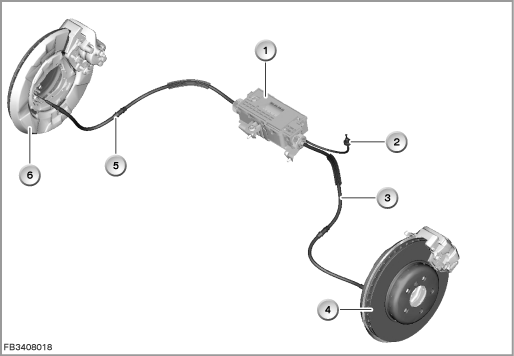
The parking brake is designed to secure the parked vehicle against rolling away. When the engine is turned off, the EMF takes over braking: electromechanically via the servo unit. When the engine is running, braking is control by the Dynamic Stability Control (DSC): hydraulically via the 4 wheel brakes.
Index |
Explanation |
Index |
Explanation |
|---|---|---|---|
1 |
Parking brake actuating unit |
2 |
Emergency release |
3 |
Bowden cable to duo-servo brake shoe, left |
4 |
Brake disc, rear left |
5 |
Bowden cable to duo-servo brake shoe, right |
6 |
Brake disc, rear right |
The Bowden cables are adjusted electromechanically via the electric motor with flanged-on transmission. Here, each of the Bowden cables act on an expander lock that sets the drum brake on the back wheel. The force sensor delivers the EMF control module the actuating force. The actuating force must be registered to ensure the required brake force. A spring is integrated in the force sensor in which the Bowden cables end. The force sensor measures the travel when the springs are compressed. The travel measurement is based on the Hall effect.
Structure and inner circuit
The EMF is connected to the PT-CAN.
The actuating unit is attached to the rear-axle member. The actuating unit is parking brake is sealed and water-tight. The housing cannot be opened in service.
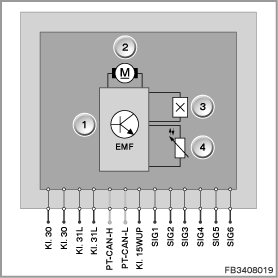
The actuating unit consists of:
- EMF control module
- Electric motor
- Transmission
- Force sensor
Index |
Explanation |
Index |
Explanation |
|---|---|---|---|
1 |
EMF control module |
2 |
Electric motor actuating unit |
3 |
Force sensor (Hall sensor) |
4 |
temperature sensor |
The dynamic stability control (DSC) is the master control module for the electromechanical parking brake (EMF). With the engine running, the dynamic stability control (DSC) engages the parking brake. The DSC also delivers the conditioned wheel-speed to the EMF in the form of a frequency-modulated signal. The signal is determined from the speed of the two rear wheels. The signal is transferred across a separate line. The signal is particularly important for detection of the vehicle standstill. The ICM control module sends the driving speed to the EMF. In addition to the plausibility check, the transmission output speed of the automatic transmission is used.
Pin assignments
Pin |
Explanation |
|---|---|
Terminal 30 |
Terminal 30, power supply |
Terminal 30 |
Terminal 30, power supply |
Terminal 31L |
Terminal 31, load earth |
Terminal 31L |
Terminal 31, load earth |
PT-CAN-H |
Powertrain CAN High |
PT-CAN-L |
Powertrain CAN Low |
Terminal 15 WUP |
Terminal 15 wake-up (wake-up line) |
SIG1 |
Speed signal, front left (hard-wired) |
SIG2 |
Signal switch 1, parking brake button |
SIG3 |
Signal switch 2, parking brake button |
SIG4 |
Signal switch 3, parking brake button |
SIG5 |
Signal switch 4, parking brake button |
SIG6 |
Activation of function indicator lamp for parking brake button |
Characteristic curve and target values
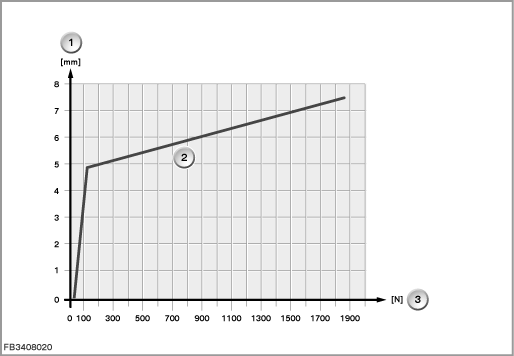
The brake force at the wheels must be 1600 Newton ±10 %. The difference between left and right may be a maximum of 10% of the lower of the two values. The pickup time here must be less than 1.6 seconds.
Index |
Explanation |
Index |
Explanation |
|---|---|---|---|
1 |
Adjustment path |
2 |
Characteristic curve for duo-servo parking brake |
3 |
Tightening force |
|
|
Observe the following target values for the electromechanical parking brake:
Variable |
Value |
|---|---|
Load change (maintenance-free throughout service life) |
50.000 |
Power supply |
9 to 16 Volts |
Tensile force at the brake shoe expander of the duo-servo parking brake |
1600 N ± 10% |
Temperature range |
-40 to 90 °C |
Diagnosis instructions
Failure of the component
If the electromechanical parking brake fails, the following behaviour is to be expected:
- Indicator lamp in the instrument cluster
As fail-safe, position P is engaged by the automatic transmission. A rolling vehicle is detected by the DSC via the wheel-speed signal.
After emergency release of the parking brake, it might be that the vehicle still cannot be moved after an interruption to the power supply. The parking lock of the automatic transmission can still be engaged. When the parking brake is released with an emergency procedure, run commissioning:
Firmly press the brake. After ignition on, press the parking brake button downwards once. The emergency release mechanism is locked. The parking brake closes automatically. This runs a detection of a cable break via the force sensor. Subsequently, the parking brake opens automatically.
No liability can be accepted for printing or other faults. Subject to changes of a technical nature