Rain-light-solar-condensation sensor
Rain-light-solar-condensation sensor
The rain sensor uses transmit and receive diodes (infrared) to evaluate the degree of reflection from the windscreen. The grouping of transmit and receive diodes in pairs creates measurement paths. The rain intensity is detected via the measurement paths.
The light sensor picks up the brightness surrounding the vehicle (ambient light) as well as the light in front of the vehicle (forward area light).
These signals are also used to control the automatic activation of deactivation of the low beam depending on the ambient situation.
The solar sensor is used for the range of functions of the integrated automatic heating and air conditioning system (IHKA). The solar sensor measures the sunlight on the vehicle. The sunlight on the driver's side and passenger's side are detected separately.
The condensation sensor enables the IHKA to detect window condensation at an early stage, even before the driver can detect it. Countermeasures can be initiated at an early stage without the driver needing to intervene.
The rain-light-solar-condensation sensor is connected across a LIN bus to the junction box. The rain-light-solar-condensation sensor is supplied with voltage via terminal 30B.
The rain-light-solar-condensation sensor is installed in the mirror base. The rain-light-solar-condensation sensor is locked in place on a retaining plate by means of a retaining spring. The retaining plate is firmly bonded to the inside of the windscreen.
The optical connection of the rain-light-solar-condensation sensor to the windscreen is established by a silicone gel on the optical element.
Functional description
The following functions are described:
- Rain sensor system
- Light sensor system
- Condensation sensor system
- Solar sensor system
Rain sensor system:
Rain detection is based on the reflexion of the infrared light where the glass of the windscreen encounters the air. The reflexion depends on the how dirty and wet the windscreen is. If the windscreen is dry and clean, the infrared light is fully reflected. If the windscreen is soiled or wet by rain, the reflexion is reduced.
Light sensor system:
The light sensor system consists of the following sensors.
- Sensor for surrounding brightness (environment)
- Sensor for frontal light (forward area)
- HUD sensor (controls brightness of the Head-Up Display)
The light sensor system sends the driving light situation (i.e. low beam ON or OFF, reason for activation) across the LIN bus by means of a message in a cycle of 20 milliseconds.
The junction box electronics (JBE) adopt the signals into the corresponding CAN message and send this in cycles (signal values unchanged) or event-controlled (signal values changed). This provides the footwell module (FRM) with the request to switch the low beam on or off when the Automatic Light Control is activated.
The signals are:
- Status of light sensor
- Status of low beam
- Level of surrounding brightness
- Reason for activation (e.g. daytime, dusk, tunnel, nighttime)
The HUD sensor, which has a maximum angle of view of 7° under the horizontal, controls the brightness of the Head-Up Display (HUD).
Condensation sensor system:
The condensation sensor provides the following information:
- Temperature on inside of the windscreen
- Atmospheric humidity on inside of the windscreen
The IHKA control module uses this information to prevent the formation of condensation on the windscreen in the automatic program.
Solar sensor system:
The solar sensor enables the integrated automatic heating and air conditioning system to take account of solar radiation.
The sunlight on the driver's side and passenger's side are detected separately.
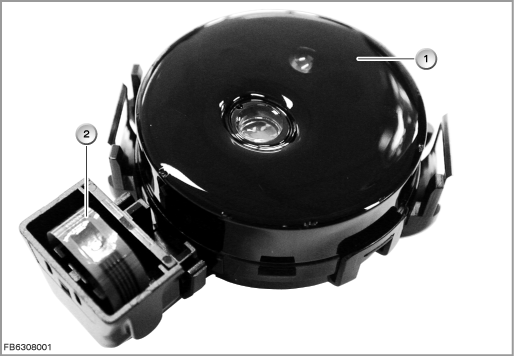
Index |
Explanation |
Index |
Explanation |
|---|---|---|---|
1 |
Rain-light-solar sensor |
2 |
Flexible circuit board with condensation sensor |
Structure and inner circuit
The rain-light-solar-condensation sensor consists of:
- Transmit diodes (infrared)
- Receive diodes (infrared)
- Photo diodes
- Optical elements
- Electronic evaluation unit
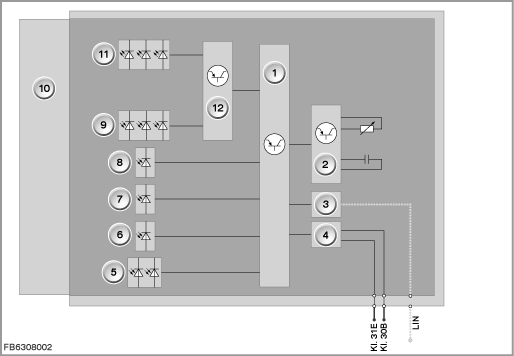
Index |
Explanation |
Index |
Explanation |
|---|---|---|---|
1 |
Electronic module |
2 |
Electronic evaluation unit for humidity and temperature (for function of condensation sensor) |
3 |
Data interface (LIN bus) |
4 |
Component for power supply |
5 |
Receive diode (infrared, for function of solar sensor) |
6 |
Photo diode for frontal light (for function of HUD sensor) |
7 |
Receive diode for frontal light (infrared, for function of light sensor) |
8 |
Photo diode for surrounding brightness (for function of light sensor) |
9 |
Receive diode (infrared, for function of rain sensor) |
10 |
Optical element |
11 |
Transmit diodes (infrared, for function of rain sensor) |
12 |
Electronic evaluation unit (for function of rain sensor) |
Pin assignments
Pin |
Explanation |
|---|---|
Kl. 30B |
Terminal 30B, power supply 9 Volts to 14 Volts |
Kl. 31E |
Terminal 31, electronics earth |
LIN |
LIN bus |
Target values
Observe the following target values for the rain-light-solar-condensation sensor:
Variable |
Value |
|---|---|
Voltage range |
9 to 14 V |
Overvoltage |
Greater than 17.5 V |
Undervoltage |
Less than 9 V |
Maximum current consumption |
Less than 0.05 A |
Temperature range |
-40 to 85 °C |
Diagnosis instructions
Failure of the component:
The rain-light-solar-condensation sensor only provides information. This means that the rain-light-solar-condensation sensor does not intervene directly in the function of other actuators. The corresponding modules (e.g. light control or wiper control) must ensure that a safe state is assumed in the vehicle if the sensor signals fail.
If the component fails, the following behaviour is to be expected:
- Failure of rain sensor system
- Fault memory entry in the junction box electronics (JBE)
- If the rain sensor fails during operation, the windscreen wiper is switched to fixed intermittent operation (emergency operation).
- Fault memory entry in the junction box electronics (JBE)
- Failure of light sensor system
- Fault memory entry in the junction box electronics (JBE)
- If the light sensor fails, the low beam is switched on automatically (precondition: light switch in position for automatic headlamp control).
- If the message from the light sensor fails briefly, the low beams switch on automatically (precondition: light switch in position for automatic headlamp control). The low beam is only switched off with the signal terminal 15 OFF.
- Fault memory entry in the junction box electronics (JBE)
- Failure of condensation sensor system
- Fault memory entry in the junction box electronics (JBE)
- If the condensation sensor fails, the IHKA control module does not run the program to prevent window condensation.
- Fault memory entry in the junction box electronics (JBE)
- Failure of solar sensor system
- Fault memory entry in the junction box electronics (JBE)
- If the solar sensor fails, the solar radiation cannot be taken into account in the IHKA control module.
- Fault memory entry in the junction box electronics (JBE)
General information
A clean, dry and undamaged windscreen surface is necessary for installation of the rain-light-solar-condensation sensor. The rain-light-solar-condensation sensor must be connected to the windscreen without the formation of bubbles.
Small air bubbles disappear some time (a few hours) after assembly of the rain-light-solar-condensation sensor.
Soiling (e.g. streaks due to worn wiper blades) in the sensitive area of the sensor can lead to malfunctions of the windscreen washer system.
Restrictions due to factors inherent in the system
- Rain sensor
Soiling (e.g. salt residues, insects) on the sensor surface can activate the windscreen washer system. If the soiling cannot be removed by the wipers, the rain sensor internally reduces its sensitivity.
This means that the condition of the wiper blades is decisive for the automatic wiper control.
This means that in the event of customer complaints regarding the automatic wiper control the condition of the wiper blades is to be checked first. If traces of wear are visible, the wiper blades must be replaced. The rain sensor then detects the improved wiping characteristics and internally increases its sensitivity.
Initialization of the rain sensor is ineffective and not necessary.
To take account of the subjective assessment of different types of rain by the vehicle user, the sensitivity of the rain sensor can be varied (knurled wheel on the steering column lever). - Light sensor
The light sensor is unable to detect negative influences on sight such as high fog, ground fog, heat haze and smoke.
The light sensor is brightness-controlled and is unable to detect different visibility conditions.
The means that the automatic headlamp control switches on too frequently with blue sky and a low sun and too infrequently with dense clouds.
In strongly illuminated tunnel entrances, the switch-on characteristics can be delayed of the brightness values in the tunnel are above the switch-on threshold.
Service functions
Encoding the rain-light-solar-condensation sensor
Encoding of the rain-light-solar-condensation sensor is required:
- After replacing the windscreen
- After replacement of a rain-light-solar-condensation sensor
At each new start, the junction box electronics (JBE) check whether the encoding data stored in the rain-light-solar-condensation sensor match the target encoding data stored in the junction box electronics.
In the event of deviations, the junction box electronics run automatic encoding of the rain-light-solar-condensation sensor in accordance with the target encoding data.
The automatic headlamp control control provides a encoding possibility to change the sensitivity settings (Japanese version: changed sensitivity settings).
Initialization of the rain sensor
In order to ensure perfect function of the optical measurement procedure for the detection of precipitation, the rain sensor must be adapted to the windscreen (initialized).
Requirement for faultless initialization is that the windscreen glass is dry, clean, undamaged and free of defects in the area of the rain sensor.
The initialization is performed using the service function 'Initialize rain sensor' in the BMW diagnosis system. This service function recalibrates the transmit and receive diodes of the rain sensor to the windscreen.
No liability can be accepted for printing or other faults. Subject to changes of a technical nature