Fuel pressure / temperature sensor
Fuel pressure / temperature sensor
The fuel temperature and pressure are detected by a combined sensor fitted in the fuel feed directly before the high-pressure pump.
The fuel temperature sensor measures the fuel temperature before the high-pressure pump. The fuel pressure / temperature sensor measures the pressure in the fuel low pressure system before the high-pressure pump. The fuel delivery pressure is used by the Digital Diesel Electronics (DDE) to activate the electric fuel pump in line with requirements. The sensor is also a protection against engine overheating and is used to calculate the fuel injection rate.
Functional description
The fuel-pressure sensor delivers a voltage signal to the DDE. In fuel-pressure sensor, a steel-plate membrane converts the fuel pressure into a path. This path is converted by 4 pressure-sensitive resistors into a voltage signal.
The fuel pressure / temperature sensor contains a temperature-dependent resistor that protrudes into the fuel and assumes its temperature. The resistor has a negative temperature coefficient (NTC). The resistance falls with increasing temperature. The resistance changes depending on the temperature from 75.5 k to 87.6 , which corresponds to a temperature of -40 °C to 120 °C.
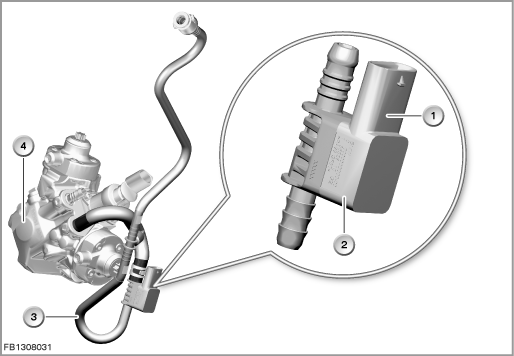
Index |
Explanation |
Index |
Explanation |
|---|---|---|---|
1 |
4-pin plug-in connection |
2 |
Fuel pressure / temperature sensor |
3 |
Fuel feed line |
4 |
High-pressure pump |
Structure and inner circuit
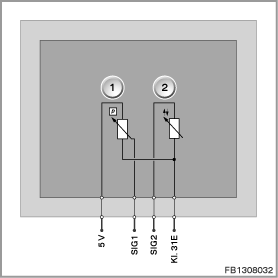
The fuel pressure / temperature sensor is connected by means of a 4-pin plug-in connection.
The fuel-pressure sensor receives earth and a power supply of 5 Volts from the DDE control module ground.
The resistor of the fuel temperature sensor is part of a voltage divider circuit that is supplied with 5 Volts by the DDE control module.
Index |
Explanation |
Index |
Explanation |
|---|---|---|---|
1 |
Fuel-pressure sensor |
2 |
Fuel temperature sensor |
Pin assignments
Pin |
Explanation |
|---|---|
5 V |
5 Volts, power supply |
SIG1 |
Signal from fuel-pressure sensor |
SIG2 |
Signal from fuel-pressure sensor |
Kl. 31E |
Terminal 31, electronics earth of both sensors |
Characteristic curve and target values
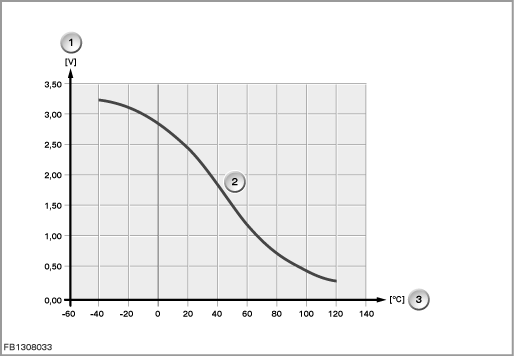
The electrical voltage at the resistor depends on the fuel temperature. A table that specifies the associated temperature for each voltage value is stored in the engine management system. This compensates for the non-linear relationship between electrical voltage and temperature.
Characteristic curve for fuel temperature sensor
Index |
Explanation |
Index |
Explanation |
|---|---|---|---|
1 |
Voltage |
2 |
Characteristic curve for fuel temperature sensor |
3 |
Temperature |
4 |
|
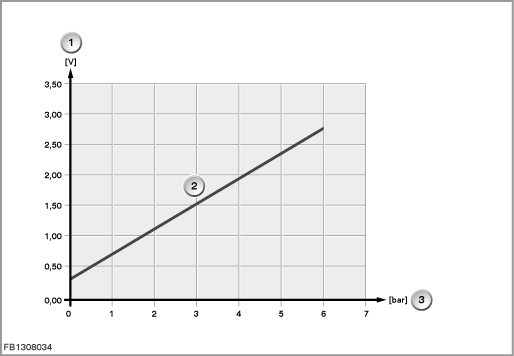
Characteristic curve for fuel-pressure sensor
Index |
Explanation |
Index |
Explanation |
|---|---|---|---|
1 |
Voltage |
2 |
Characteristic curve for fuel-pressure sensor |
3 |
4 |
|
Observe the following target values for the fuel pressure / temperature sensor:
Variable |
Value |
|---|---|
Power supply |
5 V |
Pressure measuring range |
0 to 6 bar |
Maximum current consumption |
15 mA |
Response time for fuel-pressure sensor |
5 ms |
Response time for fuel temperature sensor |
Less than 15 s |
Temperature range |
-40 °C to 125 °C |
Diagnosis instructions
Failure of the component
If the fuel pressure / temperature sensor fails, the following behaviour is to be expected:
- Fault memory entry in the engine control module
- Emergency operation with substitute value
No liability can be accepted for printing or other faults. Subject to changes of a technical nature