Exhaust gas recirculator
Exhaust gas recirculator
The exhaust gas recirculation is a measure to reduce the formation of nitrogen oxide (NOX). Nitrogen oxides are created in great quantities when combustion runs with an air surplus and at very high temperature. Here, the oxygen combines with the nitrogen of the combustion air to form nitrogen monoxide (NO) and nitrogen dioxide (NO2). On the diesel engine, exhaust gas recirculation is sometime required at idle speed and always in the part-load range, because a particularly high air surplus is used there. The recirculated exhaust gas, to which fresh air is added and which has the same properties as inert gas, achieves the following:
- Lower oxygen and nitrogen content in the cylinder
- Lowering of the maximum combustion temperature by up to 500 °C. This effect is enhanced further if the recirculated exhaust gases are cooled.
Functional description
The exhaust gas recirculator is opened or closed electrically by the DDE control module. To ensure optimized control of the exhaust gas recirculation rate, the exact position must be continuously detected. The position of the exhaust gas recirculator is monitored by a non-contact Hall sensor.
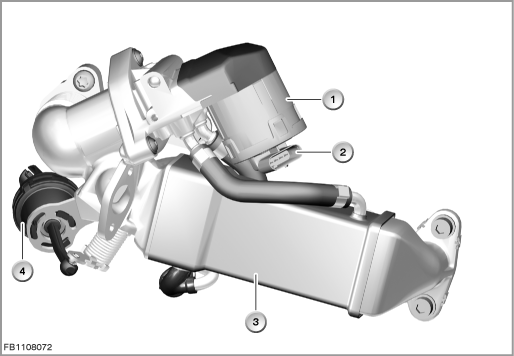
Index |
Explanation |
Index |
Explanation |
|---|---|---|---|
1 |
Exhaust gas recirculator |
2 |
5-pin plug-in connection |
3 |
Exhaust gas recirculation cooler |
4 |
Bypass valve for exhaust-gas recirculation cooler |
The quantity mean value adaptation serves to adapt the exhaust gas recirculation more precisely to tolerance in the fuel injection rates. The oxygen sensor value measured by the oxygen sensor and the air mass measured by the hot-film air-mass sensor are used to determine a mean fuel injection rate across all cylinders. This value is compared with the fuel injection rate specified by the DDE control module. If there is a deviation, the air mass is adapted to the actual fuel injection rate by adjusting the exhaust gas recirculator in such a way that the correct oxygen sensor value is set. The quantity mean value adaptation is not a rapid control operation, rather an adaptive learning procedure. That means that the fuel injection rate fault is learned in an adaptive characteristic map that is stored permanently in the DDE control module.
Structure and inner circuit
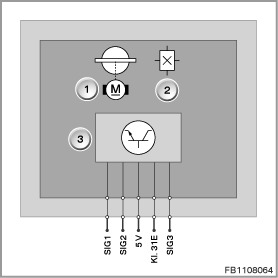
The actuator motor for the exhaust gas recirculator is a DC motor.
The position sensor is a Hall sensor. The Hall sensor determines the revolutions of the actuator motor. This is used to calculate the position of the exhaust gas recirculator.
Index |
Explanation |
Index |
Explanation |
|---|---|---|---|
1 |
Exhaust gas recirculator |
2 |
Hall-effect sensor |
3 |
Electronic module with electronic evaluation unit |
|
|
Pin assignments
Pin |
Explanation |
|---|---|
SIG1 |
Activation of exhaust gas recirculator, plus |
SIG2 |
Activation of exhaust gas recirculator, minus |
5 V |
Power supply for Hall sensor |
Kl. 31E |
Hall sensor ground |
SIG3 |
Hall sensor signal |
Schematic overview and target values
The Hall sensor is supplied with 5 Volts and ground by the DDE.
A bridge circuit (H bridge) is used to activate the actuator motor. This permits activation of the actuator motor in the opposite direction. The bridge circuit is monitored for diagnosis.
H bridge refers to an electrical gearshift where 5 shift elements are interconnected in the shape of the upper case letter H.
Index |
Explanation |
Index |
Explanation |
|---|---|---|---|
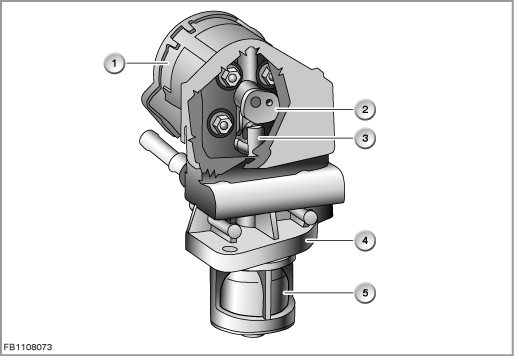
1 |
Exhaust gas recirculator |
2 |
Cam disc |
3 |
Tappet |
4 |
Housing |
5 |
Seat |
|
|
Observe the following target values for the exhaust gas recirculator:
Variable |
Value |
|---|---|
Power supply of actuator motor |
12 Volts |
Activation frequency for actuator motor |
1300 Hz |
Blocking current for actuator motor |
5 A |
Power supply for Hall sensor |
4.5 to 5.5 V |
Current consumption of Hall sensor |
20 mA |
Temperature range of Hall sensor and actuator motor |
-40 °C to 140 °C |
Diagnosis instructions
Failure of the component
If the Hall sensor fails, the following behaviour is to be expected:
- Fault memory entry in the engine control module
- Emergency operation with substitute value (limited engine torque)
- Check Control message
If the actuator motor fails, the following behaviour is to be expected:
- Fault memory entry in the engine control module
- No exhaust gas recirculation
- Check Control message
General information
If the exhaust gas recirculation (EGR) valve is replaced, the following service function must be run before the replacement:
- Adaptation of exhaust gas recirculator
No liability can be accepted for printing or other faults. Subject to changes of a technical nature