oxygen sensor before catalytic converter
oxygen sensor before catalytic converter
The Lambda oxygen sensor before catalytic converter is a broadband Lambda oxygen sensor (control sensor).
The broadband Lambda oxygen sensor continuously measures the residual oxygen in the exhaust gas. The fluctuating values of the residual oxygen are forwarded to the engine control module as a voltage signal. The engine management system corrects the fuel trim composition by means of fuel injection.
New is the enhanced broadband Lambda oxygen sensor, LSU ADV (Bosch). LSU stands for ”Oxygen Sensor Universal” and ADV for ”Advanced”.
Functional description
The sensor system of the broadband oxygen sensor consists of ceramic layers of zirconium dioxide (laminate). The heating element inserted in the laminate rapidly ensures the required operating temperature of at least 760 °C. The broadband oxygen sensor has 2 cells, a so-called measurement cell and a reference cell. The two cells are coated with electrode made of platinum.
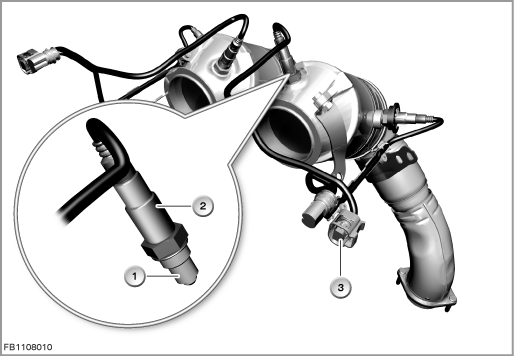
Index |
Explanation |
Index |
Explanation |
|---|---|---|---|
1 |
Broadband oxygen sensor |
2 |
Housing |
3 |
6-pin plug-in connection |
|
|
The broadband oxygen sensor can be used to steplessly measure a fuel-air ratio between 0.65 and air (constant characteristic curve). The broadband Lambda oxygen sensor becomes operational more quickly than the predecessor version, LSU 4.9.
For complete and perfect combustion, a fuel-air ratio of 1 kilogram of fuel and approx. 14.7 kilograms of air is necessary. The ratio of the air mass actually delivered to stoichiometric air mass is referred to as the Lambda. During normal operation of the vehicle, the oxygen sensor value (Lambda) fluctuates. The engine has its best performance with a lack of air (Lambda approx. 0.9 = rich mixture). The engine has its lowest consumption with an air surplus (Lambda approx. 1.1 = lean mixture). The catalytic converter achieves the best reduction in the pollutant emissions when the mixture is in the range of Lambda = 1. The conversion rate, i.e. the proportion of converted pollutants, is 98 % to virtually 100 % in the case of modern catalytic converters. The optimal composition of the fuel-air mixture is controlled by the engine management system. The oxygen sensors deliver essential information on the composition of the emissions.
Structure and inner circuit
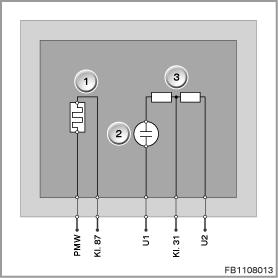
A voltage is applied to the pump cell. This means that oxygen ions are pumped into the measurement cell until a voltage of 450 mV settles between the electrodes of the measurement cell. The resulting pump current is the measured variable for the fuel-air ratio. This enables the oxygen sensor control to set any desired fuel-air ratio in the combustion chamber.
Index |
Explanation |
Index |
Explanation |
|---|---|---|---|
1 |
Oxygen sensor heating |
2 |
Reference cell (Nernst cell) |
3 |
Measurement cell (Nernst and pump cell) |
|
|
Pin assignments
Pin |
Explanation |
|---|---|
PWM |
Pulse-width modulated activation of the oxygen sensor heating |
Kl. 87 |
Battery voltage, terminal 15 on |
U1 |
Voltage of reference cell |
Kl. 31 |
Virtual ground |
U2 |
Voltage at pump cell |
Characteristic curve and target values
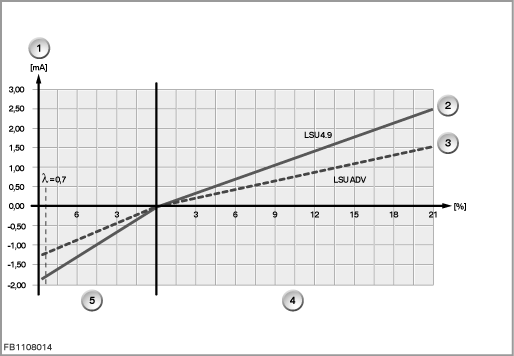
The new Lambda oxygen sensor features an extended measuring range as of Lambda value = 0.65. Other advantages of the new control sensor are the higher temperature resistance, shortened response times of under 30 milliseconds, as well as high signal accuracy.
Index |
Explanation |
Index |
Explanation |
|---|---|---|---|
1 |
Pump current |
2 |
Characteristic curve for Lambda oxygen sensor LSU 4.9 |
3 |
Characteristic curve for Lambda oxygen sensor LSU ADV |
4 |
Concentration of oxygen (lean mixture) |
5 |
Concentration of oxygen (rich mixture) |
|
|
Observe the following target values for the broadband Lambda oxygen sensor:
Variable |
Value |
|---|---|
Voltage range of oxygen sensor heating |
10.7 to 16.5 V |
Voltage of oxygen sensor heating warming phase |
1.8 to 2 V |
Voltage of oxygen sensor heating up to 5 seconds |
12 V |
Voltage oxygen sensor heating up to 6.5 seconds |
9 V |
Operating temperature |
760 °C |
Heater resistor at 20 °C |
2.0 to 3.2 |
Maximum pump current, air |
1.5 mA |
Diagnosis instructions
Failure of the component
If the broadband Lambda oxygen sensor fails, the following behaviour is to be expected:
- Fault memory entry in the engine control module
- Adaptation or emergency operation with substitute value
- The emissions warning lamp lights up in the instrument cluster
General information
The following monitoring functions of the diagnosis check the state of the engine and of the exhaust system:
- Lambda adaptation
Lambda adaptation (fuel mixture adaptation) serves the purpose of compensating for component tolerances that influence the mixture and ageing effects. - Catalytic converter diagnosis
The diagnosis check the oxygen accumulation capability of the catalytic converter. The oxygen accumulation capability is a measurement for the conversion capability of the catalytic converter.
No liability can be accepted for printing or other faults. Subject to changes of a technical nature