Oil condition sensor
Oil condition sensor
The oil condition sensor increases the function range of the thermal oil level sensor. The oil condition sensor measures the following variables:
- Engine oil temperature
- Oil level
- Dielectric conductivity
The engine management system evaluates these measurements. With the oil condition sensor, the electrical properties of the engine oil are also determined. The characteristics change with wear of the engine as well as changes to the engine oil (e.g. ageing, deposits).
Functional description
The oil condition sensor is attached to the oil sump and is accessible from below. On all new engine types (except diesel engines), there is no longer a dipstick. All engines have an electronic oil level check.
The oil condition sensor consists of 2 cylindrical condensers. The condensers are mounted above one another. 2 metal tubes are inserted one into the other to serve as electrodes. The engine oil is used as a dielectric medium between the electrodes.
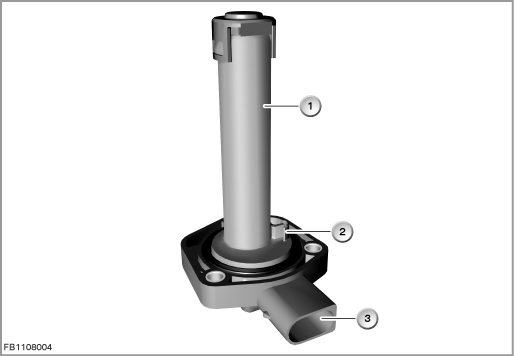
Index |
Explanation |
Index |
Explanation |
|---|---|---|---|
1 |
Meter tube for determining the level |
2 |
Temperature sensor |
3 |
3-pin plug-in connection |
|
|
Note! Explanation of the terms 'dielectric' and 'permittivity'.
A dielectric is defined as a non-conductive material in an electrical field. The electrical field is interspersed by an insulator. The permittivity (Latin: permittere = permit, let through) is also referred to as the dielectric conductance. The permittivity specifies the degree to which materials allow electrical fields to pass. The factor indicates by how much the voltage at a capacitor drops when a dielectric, non-conducting material is arranged between the capacitor plates.
The temperature sensor is seated on the housing of the oil condition sensor. The housing of the oil condition sensor contains an electronic evaluation unit. The electronic evaluation unit has self-diagnosis. A fault in the oil condition sensor is entered in the fault memory of the engine management system.
The electrical material properties of the engine oil change as the engine oil wears and ages. The changed electrical properties of the engine oil (dielectrics) cause the capacity of the capacitor to change.
The electronic evaluation unit converts the measured capacity into a digital signal. The digital sensor signal is sent to the engine management system. The engine management system uses the signal for internal calculations (e.g. condensate in the engine oil).
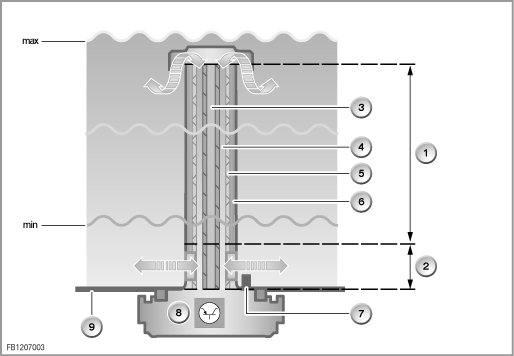
The oil level is measured for the electronic oil level check. The 2nd capacitor in the upper part of the oil condition sensor registers the oil level with the engine running. The capacitor is at the same level as the oil level in the oil sump. As the oil level changes, the capacitance of the capacitor changes. The electronic evaluation unit creates a digital signal from this. From this, the engine management computes the engine oil level. The electronic oil level check is displayed on the Central Information Display (CID) as well as in the instrument cluster. On vehicles without a CID, the oil level is only displayed in the instrument cluster.
Structure and inner circuit
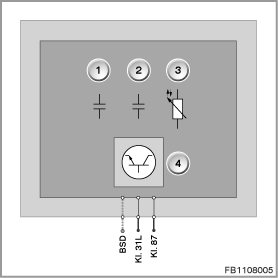
The oil condition sensor is connected via a bit-serial data interface to the engine management system. Power is supplied via terminal 87.
The electronic module contains all of the measurement electronics, which work with a capacitance measurement.
Index |
Explanation |
Index |
Explanation |
|---|---|---|---|
1 |
Capacitor 1 |
2 |
Capacitor 2 |
3 |
Temperature sensor |
4 |
Electronic module with electronic evaluation unit |
Pin assignments
Pin |
Explanation |
|---|---|
BSD |
Bit-serial data interface |
Kl. 31L |
Load ground |
Kl. 87 |
Battery voltage, ignition on. |
Measurement procedure and target values
Index |
Explanation |
Index |
Explanation |
|---|---|---|---|
1 |
Range for measuring the oil level |
2 |
Range for measuring the permittivity |
3 |
Inner capacitor |
4 |
Dielectric (engine oil) |
5 |
Outer capacitor |
6 |
Housing |
7 |
Temperature sensor |
8 |
Electronic evaluation unit |
9 |
Oil sump |
|
|
Observe the following target values for the oil condition sensor:
Variable |
Value |
|---|---|
Voltage range |
9 to 16 V |
Measuring range for oil level |
0 to 75 mm |
Measuring range for permittivity |
1 to 6 |
Permitted conductivity in the oil |
0.02 mS |
Temperature range |
-40 to 160 °C |
Diagnosis instructions
Failure of the component
If the oil condition sensor fails, the following behaviour is to be expected:
- Fault memory entry in the engine control module
- As a substitute, calculation of the service scope ”Engine oil” in the engine management system
General information
Note! condensate in the engine oil.
Condensate that forms in the crankcase due to short distance driving can influence the permittivity. The mixing of the engine oil with water that has entered means it also collects around the oil condition sensor. If there is too much water in the crankcase: In individual cases, indication of the oil level can be incorrect or a warning appears requesting the user to top up oil.
A fault pattern selection on the BMW diagnosis system can be used to treat this ”incorrect oil level warning”, whereby the permittivity of the oil is also evaluated. However, there is no direct display of the permittivity. Permittivity depends, among other things, on the viscosity and age of the oil. This means that the quality cannot always be assessed.
No liability can be accepted for printing or other faults. Subject to changes of a technical nature