Evaporator temperature sensor, rear
Evaporator temperature sensor, rear
The rear evaporator temperature sensor picks up the outlet temperature of the cooled air at the evaporator of the rear air conditioner to prevent freezing of the evaporator.
The evaporator plates are cooled by the refrigerant that has been evaporated inside the evaporator. The airflow generated by the blower is fed over the cooled evaporator plates. The air is cooled and dried and guided into the rear of the vehicle.
The evaporator temperature is regulated with the help of the evaporator temperature sensor and a controllable expansion valve. The evaporator temperature is set to the predefined specification of 2 °C. Lower temperatures are not possible due to the risk of icing.
If the ”variable evaporator control” function has been encoded, the nominal evaporator temperature is calculated between 2 and 8 °C. The specification depends on the ambient temperature, the ventilation temperature and the refrigerant pressure.
A variable evaporator temperature reduces dehumidification. This reduces the risk of mucous membranes drying out.
The rear evaporator temperature sensor is directly connected to the HKA control module (”HKA” stands for ”automatic rear air conditioning”). If the evaporator temperature falls below a specified target value (2 °C), the HKA control module activates the rear shut-off valve. The rear shut-off valve is integrated in the expansion valve of the rear air conditioner. If the rear shut-off valve closes, the refrigerant circuit of the automatic rear air conditioning is switched off.
Functional description
The evaporator temperature sensor is a hot conductor or NTC resistor (”NTC” stands for ”Negative Temperature Coefficient”).
The hot conductor means that the variable ”temperature” can be converted into the variable ”resistance” which can be electrically evaluated.
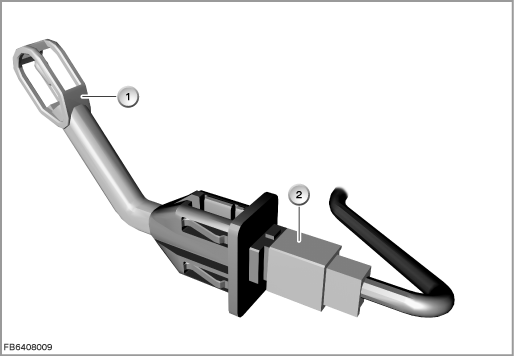
Index |
Explanation |
Index |
Explanation |
|---|---|---|---|
1 |
Evaporator temperature sensor, rear |
2 |
2-pin plug-in connection |
The current-conducting materials in the hot conductor conduct current better at high temperatures than at low temperatures. That means: With rising temperatures, the resistance falls.
Structure and inner circuit
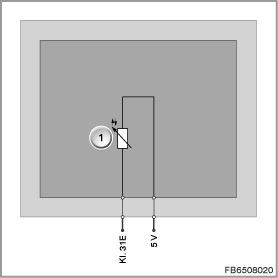
In order to balance out internal temperature effects, the hot conductor is operated with low current. This means that the outer ambient temperature is decisive for the resistance value.
Each temperature change on the hot conductor leads to a change in the voltage signal.
Index |
Explanation |
Index |
Explanation |
|---|---|---|---|
1 |
Hot conductor |
|
|
Pin assignments
Pin |
Explanation |
|---|---|
Kl. 31E |
Terminal 31, electronics ground |
5 V |
5 Volts, power supply |
Characteristic curve and target values
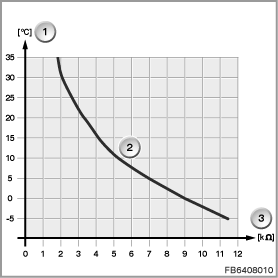
The rear evaporator temperature sensor is supplied with 5 Volts by the HKA control module. The logarithmic characteristic curve of the evaporator temperature sensor must be linearized by the microprocessor in the HKA control module. The actual temperature is then determined by means of interpolation between defined corner points.
Index |
Explanation |
Index |
Explanation |
|---|---|---|---|
1 |
Temperature in degrees Celsius (°C) |
2 |
Characteristic curve for evaporator temperature sensor |
3 |
Resistance in Kiloohms (k) |
|
|
Observe the following target values for the rear evaporator temperature sensor:
Variable |
Value |
|---|---|
Voltage range |
4.5 to 5.5 V |
Maximum current consumption |
10 mA |
Temperature range |
-5 to 60 °C |
Diagnosis instructions
Failure of the component:
If the rear evaporator temperature sensor fails, the following behaviour is to be expected:
- Fault memory entry in the HKA control module
- The refrigerant circuit of the automatic rear air conditioning is switched off via the rear shut-off valve by the HKA control module.
- Fault message:
- Short circuit to ground:
for example, resistance range less than 1.6 k. - Short circuit to positive or open line:
for example, resistance range greater than 12 k.
- Short circuit to ground:
No liability can be accepted for printing or other faults. Subject to changes of a technical nature