Glow plug
Glow plug
The combustion preheating control module is attached to the bracket of the high-pressure pump. The combustion preheating control module contains the power output stages for activation of the glow plugs.
The glow system ensures reliable cold starting characteristics and smooth engine operation when the engine is cold. The DDE control module transmits the heating request to the combustion preheating control module. The combustion preheating control module puts the request into effect by activating the glow plugs by means of a pulse-width modulated signal.
Functional description
The glow plugs have a higher temperature, a low energy requirement and short response times. Ceramic glow plugs also have a long service life. However, they must be handled with care, as the ceramic tip is very sensitive to breakage.
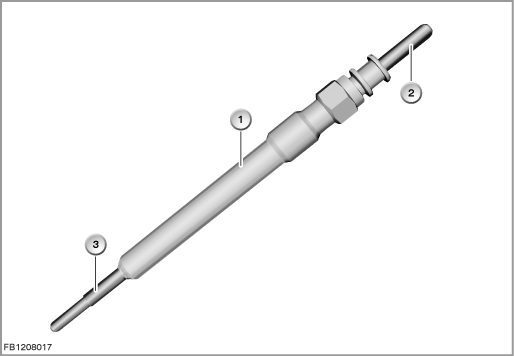
Index |
Explanation |
Index |
Explanation |
|---|---|---|---|
1 |
Glow plug |
2 |
1-pin plug-in connection |
3 |
Ceramic heating element |
|
|
The required glow plug temperature is determined by the DDE control module on the basis of the following variables:
- Engine speed
- Intake air temperature
- Fuel injection rate
- Ambient pressure
- Vehicle voltage
- Status signal for starter enable
Structure and inner circuit
To enable rapid heating up of the glow plugs, simultaneous electrical operation of all glow plugs is only permitted for 2 seconds.
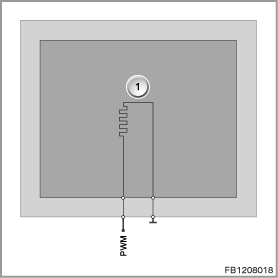
The glow plugs are activated by a pulse-width modulated signal from the combustion preheating control module. Each glow plug is switched on and off individually by an output stage assigned to that glow plug. The pulse width modulation enables changes to the effective voltage (useful voltage) at the glow plugs in such a way that an even temperature of approx. 1300 °C sets in across the entire operating range of the engine. The pulse-width modulated activation keeps the voltage at the glow plugs constant in such a way that voltage fluctuations in the vehicle network have no influence on the glow plugs and their temperature.
Index |
Explanation |
Index |
Explanation |
|---|---|---|---|
1 |
Glow plug |
|
|
Pin assignments
Pin |
Explanation |
|---|---|
PWM |
Activation of pulse width modulation |
|
Ground via housing |
Characteristic curve and target values
The glow plugs are designed for a voltage of 5.3 to 7.8 Volts. In the initial heating stage, system voltage may also be applied for a short time.
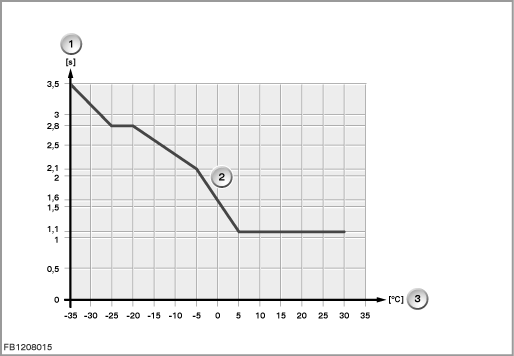
Pre-glowing is controlled via a characteristic curve depending on the coolant temperature.
Index |
Explanation |
Index |
Explanation |
|---|---|---|---|
1 |
Time |
2 |
Characteristic curve for pre-glow |
3 |
Coolant temperature |
|
|
Observe the following target values for the glow plug:
Variable |
Value |
|---|---|
Power supply for glow plug |
5.3 to 7.8 V |
Maximum continuous current for glow plugs |
32 A |
Clock frequency for pulse width modulation |
30.1 to 30.9 Hz |
Warming phase up to 1 second |
1000 °C |
Warming phase up to 2 seconds |
1300 °C |
Diagnosis instructions
Failure of the component
If the glow plug fails, the following behaviour is to be expected:
- Fault memory entry in the engine control module
General information
The combustion preheating control module does not have its own fault memory. Faults in the glow system that are detected by the combustion preheating control module are reported to the Digital Diesel Electronics by the combustion preheating control module across the LIN bus. The faults are then stored in the DDE fault memory.
The ceramic glow plugs are sensitive to impacts and bending. Glow plugs that are dropped can be damaged.
Service function
The combustion preheating control module saves certain parameters for the individual glow plugs during operation. The stored parameters must be reset when the glow plugs are replaced. Only parameters on the cylinders where a glow plug was replaced may be reset.
The service function offers 2 possibilities:
- Reset parameters of all cylinders if the glow plugs of all cylinders were replaced.
- Reset parameters of individual cylinders if the glow plugs of individual cylinders were replaced.
No liability can be accepted for printing or other faults. Subject to changes of a technical nature