Backrest heating for the driver's and/or passenger's side, rear
Backrest heating for the driver's and/or passenger's side, rear
The rear seat heating serves to set up a pleasant temperature in the rear seat back and seat cushion in the bench seat. The rear seat heating includes backrest heating and seat cushion heating.
The backrest heating for the driver's and/or passenger's side, rear consists of a seat heating pad installed in the rear seat back.
Equipment with a temperature sensor in the rear seat back depends on the seat version.
The seat heating pad is divided into heater elements. The number of heater elements depends on the seat version
.
Functional description
The rear seat heating can be switched on as of terminal 15 On separately for the driver's and passenger's side using buttons in the control panel of the FKA (rear automatic climate control). Depending on the seat version and optional equipment, the buttons can also be installed in the rear center console.
- Buttons installed in the control panel of the rear automatic climate control (FKA)
The FKA control module processes each button signal and sends a message across the K-CAN (body CAN) to the seat module on the driver's side, rear (SMFAH) and/or seat module on the passenger's side, rear (SMBFH).
Depending on the selected heating stage, the seat module generates a pulse-width modulated signal (PWM signal) that is used to operate the seat heating pad in the rear seat back.
- Buttons installed in the rear center console
The buttons are connected to the junction box electronics (JBE) via the LIN bus. The JBE processes each button signal and sends a message via the LIN bus to the seat heating module on the driver's side, rear and/or seat heating module on the passenger's side, rear.
Depending on the selected heating stage, the seat heating module generates a pulse-width modulated signal (PWM signal) that is used to operate the seat heating pad in the rear seat back.
The first time the button for the rear seat heating is pressed the seat module activates the rear seat heating and thus the backrest heating. Heating stage 3 (high heat output) is switched on. Further button pressures switch on the next-lowest heating stages 2 and 1 (medium and low heat output) or switch off the rear seat heating.
The rear seat heating is monitored by a temperature sensor (NTC resistor) in the seat cushion.
Depending on the seat version, an additional temperature sensor is installed in the rear seat back. This enables varied distribution of the heating effect to the seat cushion and rear seat via iDrive.
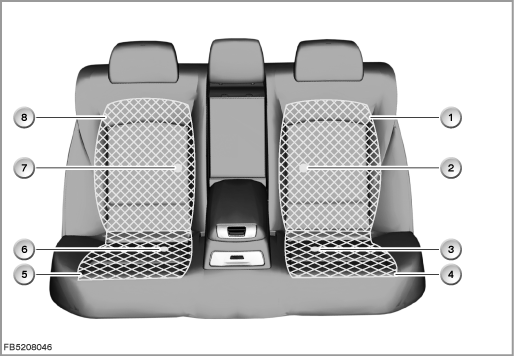
Index |
Explanation |
Index |
Explanation |
|---|---|---|---|
1 |
Seat heating pad in the rear seat back on the left |
2 |
Temperature sensor* in the rear seat back on the left |
3 |
Temperature sensor in the seat cushion, left |
4 |
Seat heating pad in the seat cushion on the left |
5 |
Seat heating pad in the seat cushion on the right |
6 |
Temperature sensor in the seat cushion, right |
7 |
Temperature sensor* in the rear seat back on the right |
8 |
Seat heating pad in the rear seat back on the right |
* Installation depends on the seat version. |
|||
Structure and inner circuit
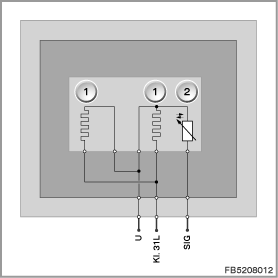
The seat heating pad is made of carbon fibre.
Seat heating pad with temperature sensor
Index |
Explanation |
Index |
Explanation |
|---|---|---|---|
1 |
Seat heating pad with heater element* |
2 |
temperature sensor |
* The number of heater elements depends on the seat version. |
|||
Pin assignments
Pin |
Explanation |
|---|---|
U |
Power supply via seat module on the driver's side, rear or on the passenger's side, rear |
Terminal 31L |
Terminal 31, load ground |
SIG |
Signal line (signal from temperature switch) |
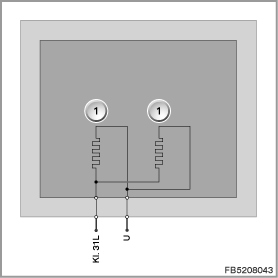
Seat heating pad without temperature sensor
Index |
Explanation |
Index |
Explanation |
|---|---|---|---|
1 |
Seat heating pad with heater element |
|
|
* The number of heater elements depends on the seat version. |
|||
Pin assignments
Pin |
Explanation |
|---|---|
U |
Power supply via seat module on the driver's side, rear or on the passenger's side, rear |
Terminal 31L |
Terminal 31, load ground |
Target values
Comply with the following target values for the backrest heating for the driver's and passenger's side, rear:
Variable |
Value |
|---|---|
Voltage range |
9 to 16 V |
Clocking of the PWM signal |
25 Hz |
Maximum surface temperature at the seat heating pad (shutdown by seat module and/or seat heating module) |
42 °C |
Temperature range |
-40 to 85 °C |
Diagnosis instructions
Failure of the component
If the backrest heating for the driver's and/or passenger's side, rear fails, the following behaviour is to be expected:
- Backrest heating activated via seat module on the driver's side, rear or on the passenger's side, rear
Fault memory entry in the seat module for the driver's side, rear (SMFAH) and/or in the seat module for the passenger's side, rear (SMBFH) - Backrest heating activated via seat heating module on the driver's side, rear or on the passenger's side, rear
Fault memory entry in the junction box electronics (JBE)
General information
The energy management in the vehicle can activate the rear seat heating with reduced function or briefly switch it off depending on the energy balance. However, the function indicator is retained.
The heat output is reduced as follows:
- Operation of the rear seat heating only in heating stage 2
- Operation of the rear seat heating in heating stage 2 with only 50% heat output
- Rear seat heating off
No liability can be accepted for printing or other faults. Subject to changes of a technical nature