Rear right actuator for pedestrian protection
Rear right actuator for pedestrian protection
The rear right actuator for pedestrian protection is a component of the pedestrian protection system and is installed in the rear right bonnet hinge.
The pedestrian protection system has the task of detecting an accident situation between a passenger car and a pedestrian in the area of the bonnet and of selectively activating the system depending on certain marginal conditions.
The pedestrian protection is a complete system consisting of a control module (crash safety module), pedestrian protection sensors (installed in the front bumper trim) and actuators.
In addition to the rear right actuator for pedestrian protection, there are the following actuators:
- Rear-left actuator for pedestrian protection
(installed in the rear left bonnet hinge) - Front-left actuator for pedestrian protection
(installed in the front left bonnet catch) - Front-right actuator for pedestrian protection
(installed in the front right bonnet catch)
The signals of the pedestrian protection sensors are evaluated in the crash safety module (ACSM).
”ACSM” stands for ”Advanced Crash Safety Module”.
If a collision with a pedestrian is registered by the pedestrian protection sensors, the crash safety module always triggers all the actuators for pedestrian protection.
This triggering is pyrotechnical. Subsequently, a spring force raises the bonnet by 30 mm at the front and 50 mm at the rear.
This enlarges the space between the inner panel of the bonnet and the attachments on the engine as well as on the body. The enlarged space increases the possible deformable area of the bonnet in the event of a head impact. Furthermore, the rigid connection of the bonnet is changed into an elastic connection by the springs in the actuators.
This enables improved energy dissipation when the head strikes the bonnet.
Functional description
If the crash safety module sends a trigger signal, the rear right actuator for pedestrian protection triggers as follows:
- The priming cap in the pyrotechnic component ignites the propellant charge.
The pyrotechnic actuator contains a priming cap whose propellant charge unlocks the two locking pins in the lid. - After this unlocking, the bonnet is raised by the force of the springs in the actuator within a few milliseconds by 50 millimetres.
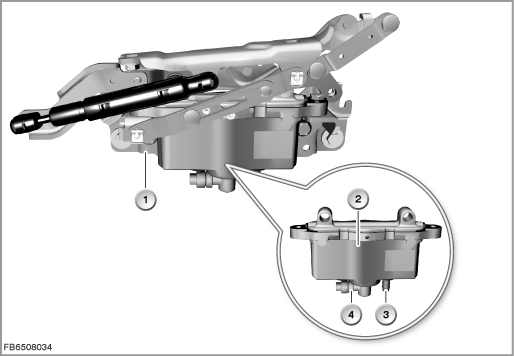
Index |
Explanation |
Index |
Explanation |
|---|---|---|---|
1 |
Rear-right bonnet hinge |
2 |
Rear right actuator for pedestrian protection |
3 |
Condensate drainage |
4 |
Pyrotechnical component (contains priming cap, propellant charge and mechanical system for activating the locking pins) |
After the system has been triggered by a sensor signal, the bonnet can be reset.
Overpressing the opened bonnet (towards open) mechanically locks the rear actuators in the bonnet hinge, that is, the locking pins in the lid catch securely in the housing part of the actuator, as the spring force causes the mechanical system in the pyrotechnic component to return to its original position (same as before triggering).
The actuators in the front bonnet catches are automatically reset after opening and subsequently closing the bonnet.
For renewed activation of the pedestrian protection system, replacement of the actuators is obligatory, as the priming cap and propellant charge in the pyrotechnical component have been used up by the triggering.
Structure and inner circuit
The crash safety module is connected to the rear right actuator for pedestrian protection via 2 signal lines.
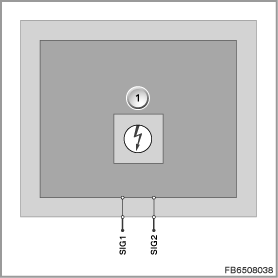
Index |
Explanation |
Index |
Explanation |
|---|---|---|---|
1 |
Rear right actuator for pedestrian protection |
|
|
Pin assignments
Pin |
Explanation |
|---|---|
SIG1 |
Signal line for trigger signal (negative side) |
SIG2 |
Signal line for trigger signal (positive side) |
Target values
Observe the following target values for the rear right actuator for pedestrian protection:
Variable |
Value |
|---|---|
Voltage range |
5 to 12 V |
Temperature range |
-40 to 110 °C |
Diagnosis instructions
Failure of the component:
If the rear right actuator for pedestrian protection fails, the following behaviour is to be expected:
- Fault memory entry in the crash safety module
- Check Control message via symbol in the instrument cluster
No liability can be accepted for printing or other faults. Subject to changes of a technical nature