Volume control valve and high-pressure pump
Volume control valve and high-pressure pump
The fuel is delivered to the high-pressure pump via the inlet with delivery pressure generated by the fuel pump. The fuel is then fed via the volume control valve into the fuel chamber of the pump element. In this pump element, the fuel is placed under pressure by a plunger and supplied via the high-pressure shut-off valve to the high-pressure connection. The high-pressure pump is bolted onto the cylinder head and is driven by the camshaft via a triple cam.
Functional description
As soon as the engine is running, the triple cam continuously moves the plunger to make its stroke. Fuel is placed under pressure until new fuel is delivered via the volume control valve into the high-pressure pump. The volume control valve is activated by the engine management system; it specifies the delivered volume of fuel. Pressure regulation takes place via the volume control valve in that it is opened or closed by the pump element towards the fuel feed. In the induction stroke, the fuel is sucked in via the opened volume control valve and delivered back again in the compression stroke into the feed until the volume control valve closes. The closing time initiates the actual delivery stroke and determines the volume of fuel that is pumped through the shut-off valve into the high pressure line.
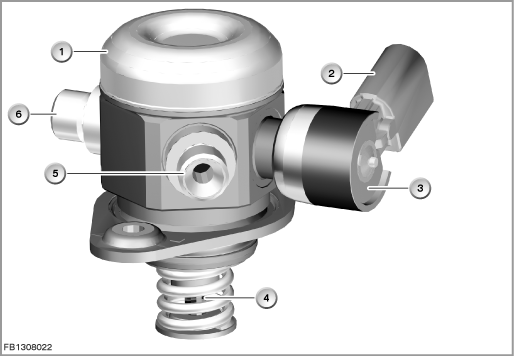
Index |
Explanation |
Index |
Explanation |
|---|---|---|---|
1 |
High-pressure pump, cylinder bank 1 |
2 |
2-pin plug-in connection |
3 |
Volume control valve |
4 |
Plunger of high-pressure pump |
5 |
Fuel feed line |
6 |
High-pressure pipe |
The volume control valve controls the fuel delivery pressure in the rail. In addition, the pressure limiting valve provides the possibility to reduce the pressure in the rail. Here, the fuel is fed out of the high-pressure system back into the pump element.
Structure and inner circuit
The volume control valve is a solenoid valve. The volume control valve is activated via a pulse-width modulated signal (PWM signal) from the engine management system. Depending on the activation signal, the ratio between return delivery in the low-pressure range and delivery stroke in the high-pressure range changes. This sets the necessary fuel mass flow for each load point. The volume control valve is supplied by the volume control valve relay with terminal 15N. The engine management system switches the relay on.
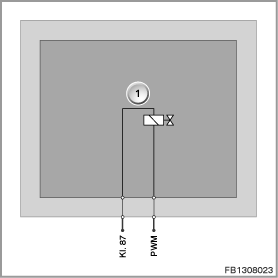
Index |
Explanation |
Index |
Explanation |
|---|---|---|---|
1 |
Volume control valve |
|
|
Pin assignments
Pin |
Explanation |
|---|---|
Kl. 87 |
Power supply for volume control valve |
SIG |
Pulse-width modulated signal |
Schematic overview and target values
The maximum pressure in the high-pressure range is restricted to 245 bar. if such a high pressure arises, the high-pressure circuit is relaxed to the low-pressure range by a pressure limiting valve. The fuel does not change its volume with the pressure change. The pressure peak that arises is compensated for on introduction into the low-pressure range by the low-pressure damper there.
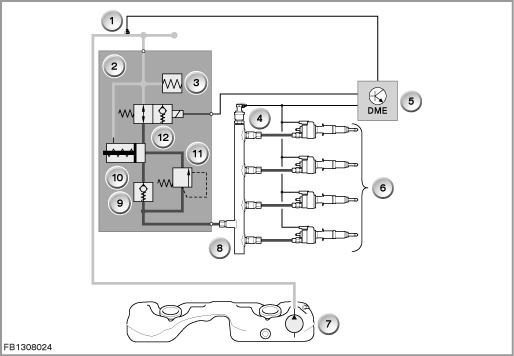
Cylinder bank 1 shown
Index |
Explanation |
Index |
Explanation |
|---|---|---|---|
1 |
Fuel low pressure sensor |
2 |
High-pressure pump |
3 |
Compensating chamber |
4 |
Rail pressure sensor |
5 |
Engine management system |
6 |
Fuel injectors |
7 |
Fuel pump |
8 |
Fuel-distribution pipe (rail) |
9 |
Non-return valve |
10 |
Plunger of high-pressure pump |
11 |
Pressure limiting valve |
12 |
Volume control valve |
Observe the following target values for the volume control valve:
Variable |
Value |
|---|---|
Minimum power supply at engine start |
6 Volts |
System pressure of high-pressure pump |
5 to 20 MPa |
Current consumption |
4.5 A |
Resistance at 20 °C |
0.5 |
Response time |
3.2 ms |
Temperature range |
-30 °C to 140 °C |
Diagnosis instructions
Failure of the component
If the volume control valve fails, the following behaviour is to be expected:
- Fault memory entry in the engine control module
- Emergency operation with substitute value
General information
In the event of mechanical failure when the volume control valve is closed,engine operation is no longer possible:
No liability can be accepted for printing or other faults. Subject to changes of a technical nature