Tank ventilation valve
Tank ventilation valve
The tank-ventilation system captures evaporated components of the fuel and feeds the components to combustion. The tank-ventilation system prevents hydrocarbons from escaping into the environment. On the one hand, the fuel expands. However, if the pressure and temperature remain the same, evaporation decreases over time, as only the light hydrocarbons evaporate. On the other hand, if there was no tank-ventilation system a partial vacuum would arise in the fuel tank when fuel is withdrawn. This is why there is aeration and ventilation in the rear of the tank.
Functional description
The tank-ventilation valve controls the regeneration of the activated carbon filter by means of purge air. The purge air drawn through the activated carbon filter is enriched with hydrocarbon (HC) depending on the load of the activated carbon. The purge air is then fed to the engine for combustion.
The creation of hydrocarbons in the fuel tank depends on:
- Fuel temperature and ambient temperature
- Air pressure
- Fill level in the fuel tank
- Time
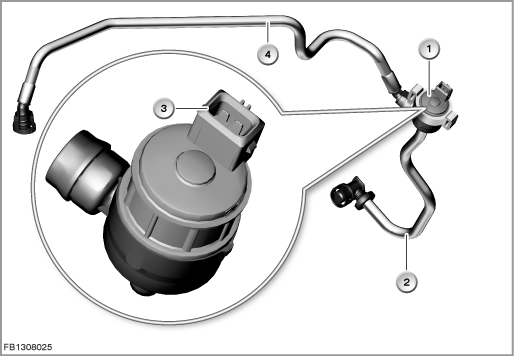
Index |
Explanation |
Index |
Explanation |
|---|---|---|---|
1 |
Tank ventilation valve |
2 |
Connection to engine |
3 |
2-pin plug-in connection |
4 |
Activated carbon filter connection |
The amount of fuel vapour drawn in by the combustion engine from the activated carbon filter must be adapted to each operating status of the engine. To achieve this, the tank-ventilation valve is activated by the engine management system by means of a pulse-width modulated signal with fixed or variable frequency.
Structure and inner circuit
The tank-ventilation valve is a solenoid valve.
When no current is applied, the tank-ventilation valve closes the fuel vapour line from the activated carbon filter to the intake pipe.
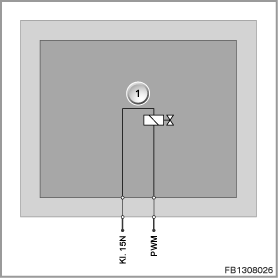
Index |
Explanation |
Index |
Explanation |
|---|---|---|---|
1 |
Tank ventilation valve |
|
|
Pin assignments
Pin |
Explanation |
|---|---|
Kl. 15N |
Terminal 15, power supply |
PWM |
Pulse-width modulated signal |
Activation and target values
With the engine off and after the engine start, the tank-ventilation valve remains closed as long as the engine temperature is still below 40 °C. However, the fuel tank is still ventilated via the activated carbon filter to the ambient air. The escaping fuel vapours are collected by the activated carbon filter.
In the 1st adaptation phase, the tank-ventilation valve is closed. For the 3 load ranges (idle speed, lower load range and medium load range), a fuel mixture adaptation as deviation to Lambda value = 1 is made at certain engine speed and load points.
In the 2nd tank ventilation phase, the tank-ventilation valve is allowed to remain open for the entire phase (270 s) as long as there are no other requests (e.g. coasting cutout or diagnosis request).
In the 2nd adaptation phase, the tank-ventilation valve is closed again. For the 3 load ranges (idle speed, lower load range and medium load range), a fuel mixture adaptation as deviation to Lambda value = 1 is made at certain engine speed and load points. All other adaptations run in exactly the same way.
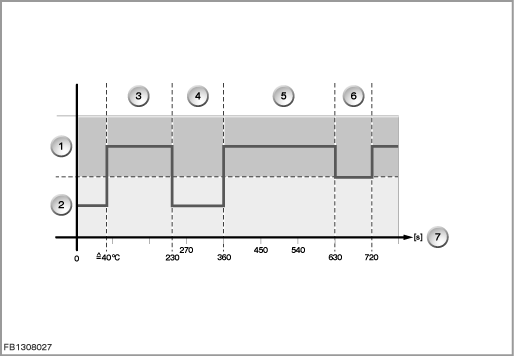
Index |
Explanation |
Index |
Explanation |
|---|---|---|---|
1 |
Tank-ventilation valve open |
2 |
Tank-ventilation valve closed |
3 |
1st tank ventilation phase |
4 |
1st adaptation phase |
5 |
2nd tank ventilation phase |
6 |
2nd adaptation phase |
7 |
Time |
|
|
Observe the following target values for the tank-ventilation valve:
Variable |
Value |
|---|---|
Voltage range |
9 to 16 Volts |
Pulse duty factor |
0 to 100 % |
Frequency range |
0 to 30 Hz |
Current consumption |
1 A |
Temperature range |
-30 °C to 140 °C |
Diagnosis instructions
Failure of the component
If the tank-ventilation valve fails, the following behaviour is to be expected:
- Fault memory entry in the engine control module
- Emergency operation with substitute value
General information
If the oxygen sensors before the catalytic converter on bank 1 and bank 2 do not deliver plausible values or if a bank is diagnosed at both oxygen sensors, the tank-ventilation valve goes into emergency operation. In emergency operation, the flow rate of the purge air depends on the engine speed and throttle-valve position (lower than during normal operation).
No liability can be accepted for printing or other faults. Subject to changes of a technical nature