VANOS intake solenoid valve
VANOS intake solenoid valve
The VANOS intake and exhaust solenoid valves are positioned axially on the front of the cylinder head. The VANOS solenoid valves (with integrated shut-off valve) distribute the engine oil pressure to the two VANOS adjustment units.
The variable camshaft control serves to enhance the torque in the lower and middle engine speed range. At the same time, the most favourable valve operation times for idle speed and maximum power output are set.
Functional description
The variable camshaft improves the torque in the lower and middle engine speed range. A greater valve overlap results in lower amounts of residual gas at idle speed. A recirculation of internal exhaust gas in the part-load range reduces the volume of nitrogen oxide. The following is also achieved:
- faster heating of the catalytic converters
- lower pollutant emissions after a cold start
- reduction in the fuel consumption
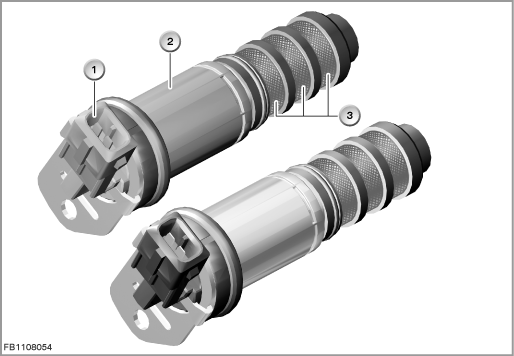
Index |
Explanation |
Index |
Explanation |
|---|---|---|---|
1 |
2-pin plug-in connection |
2 |
VANOS intake solenoid valve |
3 |
Filter insert |
|
|
A VANOS solenoid valve activates the VANOS adjustment unit. The required positions of the intake and exhaust camshafts are calculated from the engine speed and the load signal (depending on the intake-air temperature and coolant temperature). The DME control module activates the VANOS adjustment unit accordingly. The intake camshaft can be variably regulated within its maximum adjustment range. When the correct camshaft position has been reached, the VANOS solenoid valve keeps the oil volume in the actuating cylinder in both vane cell chambers constant. This holds the intake camshaft in this position. To perform the adjustment, the variable camshaft control requires an information signal on the current position of the camshaft. A camshaft sensor on the intake side picks up the position of the camshaft. On engine start, the intake camshaft is in the end position (”late”).
Structure and inner circuit
The VANOS intake solenoid valve is connected by means of a 2-pin plug-in connection.
The VANOS intake solenoid valve is a solenoid valve. The VANOS solenoid valve is supplied with voltage via terminal 15N. Activation by the engine management system is pulse-width modulated.
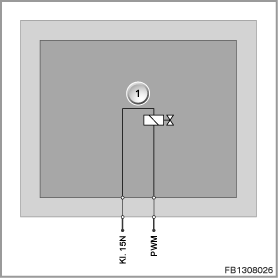
Index |
Explanation |
Index |
Explanation |
|---|---|---|---|
1 |
VANOS intake solenoid valve |
|
|
Pin assignments
Pin |
Explanation |
|---|---|
Kl. 15N |
Terminal 15, power supply |
PWM |
Pulse-width modulated signal |
Operation times diagram and target values
Idle speed:
At idle speed, the camshafts are adjusted in such a way that there is a small valve overlap or none at all. The low residual gas content leads to stable combustion and thus to stable idling. The smallest valve overlap is achieved with great to the greatest possible intake spread and the greatest possible exhaust spread. The VANOS solenoid valves are without current here. This camshaft position is also assumed on stopping the engine.
Power output:
To achieve good power output at high engine speeds, the exhaust valves are opened late. This enables the expansion of combustion to move the piston for longer. The inlet valve opens after OT and closes late after UT. This exploits the dynamic ram effects of the incoming air to enhance performance.
Torque and power output:
To achieve high torque, a high cylinder charge must be achieved. Depending on the phase relation of the intake pipe pressure peaks or intake pipe pressure troughs, the intake and/or exhaust valves must be opened and/or closed earlier or later.
Depending on the length of the intake pipe, an engine without VANOS has exactly one engine speed with the best cylinder charge.
An engine with VANOS can operate in a broad engine speed range with optimized cylinder charge. Reason: Both ejection of the fresh gases back into the intake pipe and a flow of residual gas back into the cylinder can be avoided.
Increasing torque with turbocharging
On the turbocharged engine, 'over-scavenging' - and thus significantly more torque - can be achieved at low engine speeds in the charged range with a positive scavenging divide by means of a large valve overlap. The effect: More air than necessary for combustion flows through the engine. This means the compressor is not in the pump limit. Second effect: There is virtually no more residual gas in the cylinder.
Internal exhaust gas recirculation with part-load
In contrast to the torque-optimized and power-optimized VANOS position, high exhaust gas recirculation can also be forced with adjustment of the intake and exhaust camshaft. Decisive for the amount of internal exhaust gas recirculation is: The size of the valve overlap as well as the pressure difference between the exhaust manifold and intake pipe. Internal exhaust gas recirculation has the following characteristics:
- Fast reaction times compared to external exhaust gas recirculation (with internal exhaust gas recirculation, there is no residual gas in the intake air collector)
- Fast exhaust gas heat recirculation into the cylinder (with a cold engine, the additional heat improves the fuel trim and leads to lower emission of hydrocarbons)
- Reduction in the peak temperatures of the combustion and thus a reduction in the nitrogen oxide emission
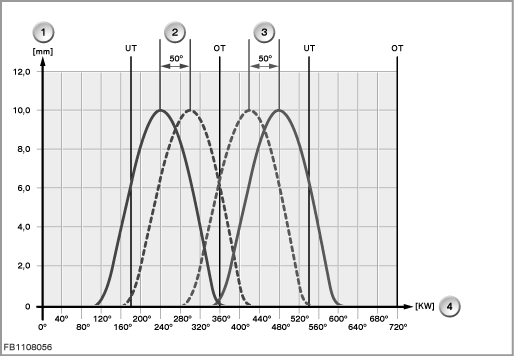
Index |
Explanation |
Index |
Explanation |
|---|---|---|---|
1 |
Valve lift |
2 |
Exhaust camshaft spread |
3 |
Intake camshaft spread |
4 |
Crankshaft degrees |
Observe the following target values for the VANOS solenoid valve:
Variable |
Value |
|---|---|
Voltage range |
9 to 16 V |
Pulse duty factor |
1 to 99 % |
Frequency of the activation signal |
200 to 250 Hz |
Coil resistance |
approx. 10.5 |
Operating pressure |
≤ 10 bar |
Temperature range |
-40 to 150 °C |
Diagnosis instructions
Failure of the component
If the VANOS solenoid valve fails, the following behaviour is to be expected:
- Fault memory entry in the engine control module
- Emergency operation
General information
The VANOS solenoid valve now has 3 filter inserts that can be removed individually when soiled: Please comply with repair instructions!
No liability can be accepted for printing or other faults. Subject to changes of a technical nature