Blow off valve
Blow off valve
The blow off valve is attached directly to the exhaust turbocharger.
In order to avoid the occurrence of strong vibrations at the impeller in the event of the throttle valve suddenly closing (e.g. during gearshift), the blow off valve opens. This creates a circuit around the compressor. The charge-air pressure is diverted to the intake side of the compressor.
Functional description
The blow off valve prevents ”pumping” against the closed throttle valve, this improving engine acoustics. In addition, the blow off valve protects the exhaust turbocharger against damage.
Another effect: the exhaust turbocharger reacts quickly when the throttle valve is opened again. Without the blow off valve, the exhaust turbocharger would work against the backpressure of the closed throttle valve and become slower. On opening the throttle valve, the exhaust turbocharger would react with a delay.
The engine management system activates the blow off valve. The blow off valve has the positions: open and closed (no intermediate positions).
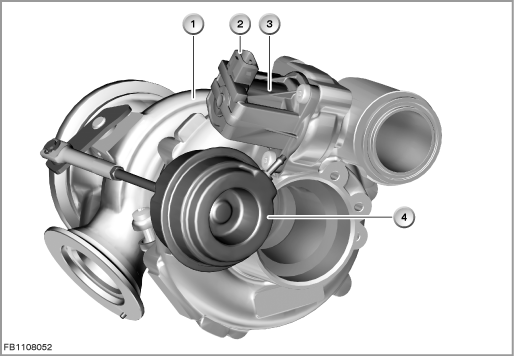
Index |
Explanation |
Index |
Explanation |
|---|---|---|---|
1 |
Exhaust turbocharger, cylinder bank 2 |
2 |
2-pin plug-in connection |
3 |
Blow off valve |
4 |
Partial-vacuum canister |
Structure and inner circuit
The blow off valve is connected by means of a 2-pin plug-in connection.
The blow off valve is a solenoid valve. The blow off valve is supplied with voltage via terminal 15N. Activation by the engine management system is on the ground side.
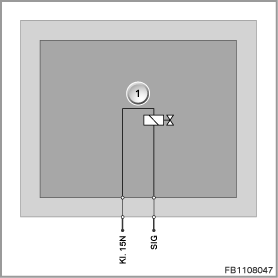
Index |
Explanation |
Index |
Explanation |
|---|---|---|---|
1 |
Blow off valve |
|
|
Pin assignments
Pin |
Explanation |
|---|---|
Kl. 15N |
Terminal 15, power supply |
SIG |
Activation of blow off valve |
Schematic overview and target values
The blow off valve reduces unwanted peaks in the charge-air pressure that can arise when the throttle valve is closed quickly.
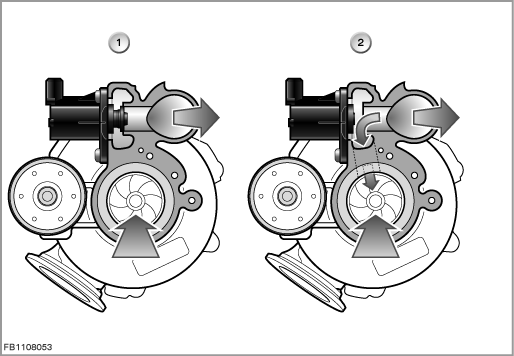
Index |
Explanation |
Index |
Explanation |
|---|---|---|---|
1 |
Blow off valve closed |
2 |
Blow off valve opened |
Observe the following target values for the blow off valve:
Variable |
Value |
|---|---|
Voltage range |
8 to 16 V |
Response time at 20 °C and 13 V |
≤ 40 ms |
Current consumption at 25 °C and 13 V |
approx. 1 A |
Temperature range |
-40 °C to 140 °C |
Diagnosis instructions
Failure of the component
If the blow off valve fails, the following behaviour is to be expected:
- Fault memory entry in the engine control module
- Emergency operation with substitute value
No liability can be accepted for printing or other faults. Subject to changes of a technical nature