Energy diagnosis
The electrical system of BMW vehicles has been subject to an ongoing development process over the last few years. This means that the demands placed on the battery have grown.
A breakdown due to a flat battery or problems in the vehicle energy system can have wide variety of causes. In most cases, these have nothing to do with the battery itself. For this reason, replacing the battery will only rarely provide a sustained solution to the problem. The energy diagnosis test module helps find the cause of the problem.
Result of the energy diagnosis
The aim of energy diagnosis is to indicate the cause of the fault as unambiguously as possible. The test module reads all the necessary data from the corresponding control modules (see below). After evaluating this data, it displays the following information:
- Possible cause of a flat battery or problem in the vehicle energy system: The number of items of information varies.
If there are a number of possible causes of the fault, the causes of the fault are allocated according to kilometre reading (last event in first place in the list).
For example: the vehicle does not 'go to sleep' (sleep inhibited); the vehicle is wakened time and again; the parking lamps were switched on for too long, etc. - General information: this information can always be displayed (results of the last closed-circuit current monitoring, information on the battery, for example battery charge statuses of the last 5 days, driving profile, stationary profile).
On the basis of the displayed information, it can then be decided what the real cause of the fault is.
Overview of possible causes
A breakdown due to a depleted battery or a problem in the vehicle energy system is not necessarily the result of a defective battery. However, in some cases the battery can be damaged - no matter what the cause. The various causes can be placed in two main categories:
- Vehicle faults:
- The vehicle does not ”go to sleep”.
- The vehicle keeps being woken up.
- Excessive closed-circuit current in the idle state.
- Faulty alternator (poor charge balance of the alternator).
- Defective battery.
- The vehicle does not ”go to sleep”.
- Unfavourable customer use:
- Parking lamps, side lamps or hazard warning lights were switched on for too long.
- Terminal R or terminal 15 was switched on for too long.
- Long parking period.
- Unfavourable driving profile (short-distance driving).
- Frequent or long-term use of auxiliary consumer units (for example, radio or rear entertainment) that can also lead to inhibited sleeping and increased power consumption.
- Parking lamps, side lamps or hazard warning lights were switched on for too long.
Data from the vehicle that is read and evaluated
This data in detail:
- Fault memory in the ZGM (central gateway module)
The ZGM monitors the vehicle status, registers inhibited sleeping or unauthorized waking, and sends a message to the JBE requesting a reset or shutdown of terminal 30F:- Inhibited sleeping:
- Inhibited sleeping:
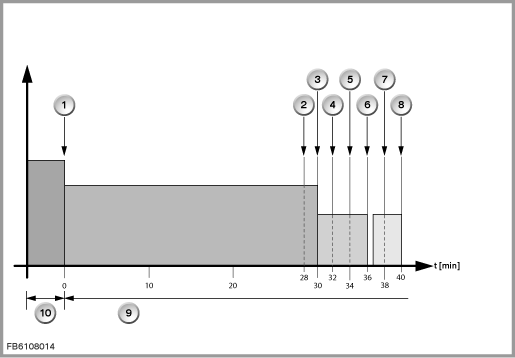
Index |
Explanation |
Index |
Explanation |
|---|---|---|---|
1 |
Terminal R OFF |
2 |
Registration of the cause or causes in the ZGM 2 min before terminal 30B off. |
3 |
Shutdown of terminal 30B (with vehicle not deadlocked or opened luggage compartment lid, 30 minutes after terminal R Off). |
4 |
2 min after terminal 30B off: Registration of the cause or causes in the ZGM. |
5 |
2 min after power down command: Registration of the cause or causes in the ZGM. |
6 |
2 minutes after request by the ZGM, the JBE runs a reset of terminal 30F. |
7 |
2 min after reset of terminal 30F: Registration of the cause or causes in the ZGM. |
8 |
2 minutes after request by the ZGM, the JBE shuts down terminal 30F. |
9 |
After terminal R off, the vehicle does not reach the idle state. |
10 |
Terminal R ON Bus communication is active. |
- Unauthorized waking:
- Unauthorized waking:
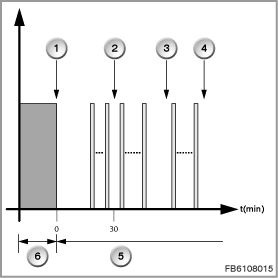
Index |
Explanation |
Index |
Explanation |
|---|---|---|---|
1 |
Terminal R OFF |
2 |
Shutdown of terminal 30B (with vehicle not deadlocked or opened luggage compartment lid, 30 minutes after terminal R Off). |
3 |
After shutdown of terminal 30B, the ZGM has registered the same waking cause 5 times or 16 wakings. |
4 |
After a reset of terminal 30F, the ZGM registers a waking that has ready occurred or has registered 16 wakings since the shutdown of terminal 30B. |
5 |
After terminal R Off, the vehicle is wakened in an unauthorized manner. |
6 |
Terminal R ON Bus communication is active. |
- Fault memory in the JBE (junction box electronics)
- Reset or shutdown of terminal 30F.
- Reset or shutdown of terminal 30F inhibited (conditions not met).
- Starting capability limit reached with terminal 15 or terminal 30B on.
- Reset or shutdown of terminal 30F.
- Energy history memory in the JBE
The energy history memory (NB: not to be confused with the history memory for fault memory entries) stores a variety information that can help in searching for the cause of problems in the vehicle energy system. The stored information of the energy history memory in detail:- The driving profile of the last 5 weeks.
- The maximum number of wakings within an off-load phase (terminal R off within the last 5 weeks.
- The driving profile of the last 5 weeks.
- Diagnosis requests of the DME/DDE
The DME/DDE stores various data that is used for the energy diagnosis:- The results of the last 24 closed-circuit current monitoring runs.
- The last registered battery replacement.
- The state of charge of the battery in the last 5 days
- The kilometre readings of the last 5 days
- Point in time and duration of the last 4 reductions or shutdowns of current consumers.
- The results of the last 24 closed-circuit current monitoring runs.
- Fault memory and diagnosis requests in the CAS (Car Access System)
- Fault memory entry with automatic shutdown of terminal 15 or terminal 30B due to reaching the starting capability limit.
- History of the last extensions of the after-run time of terminal 30B (auxiliary consumer units).
- History of the last waking causes for the CAS.
- Fault memory entry with automatic shutdown of terminal 15 or terminal 30B due to reaching the starting capability limit.
- Fault memory in the DME/DDE
The DME/DDE saves a fault memory entry in the event of a closed-circuit current fault, total battery discharge and a reduction or shutdown of current consumers. - Fault memory in the FRM (footwell module)
The FRM is responsible for control of the lights. At terminal R off, the FRM switches the parking lamps or side lamps off if the measured vehicle voltage falls below 10.6 Volts for at least 2 minutes. On shutdown, a fault memory entry is stored.